Calidad is Spanish for "quality", and Calidad Infotech is named after it on purpose. We are an AI-augmented software engineering company: AI writes much of the code, and our engineers make it right. Every release goes through tests, security checks and senior engineer review before it ships, whether a person or a model wrote the change.
This post covers where the name comes from, why quality matters more now that AI writes so much code, and what the name commits us to in daily engineering work.
What does "calidad" mean, and why name a software company after it?#
Calidad means quality: the set of properties that let you judge how good something is.
The Real Academia Española's Diccionario de la lengua española traces the word to the Latin qualitas. It gives several meanings. The first is the property or set of properties inherent in something that let you judge its value. Another is superiority or excellence. A third is how well a product or service matches its specified characteristics.
That third meaning is the one that matters in software. Does what shipped do what was specified? Can you show it? Opinions about "good code" vary. A release that meets its specification, and comes with evidence that it does, is something you can check.
We picked the name because it describes the hard part of the job. AI can write code in seconds. You still need engineers to test it, secure it and stand behind it. In the words on our home page: code is cheap now, quality isn't. AI gives us speed. Quality is the part we never hand off.
Why does software quality matter more now that AI writes code?#
AI now produces code faster than most teams can check it, and the research shows that gap growing.
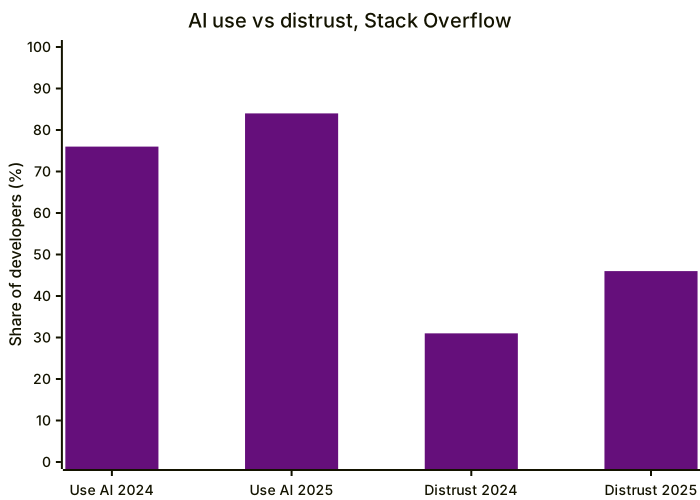
Developers use AI more each year but trust its output less. In Stack Overflow's 2025 Developer Survey, 84% of developers said they use or plan to use AI tools, up from 76% in 2024. Over the same period, the share who don't trust the accuracy of AI output rose from 31% to 46%. And 45% said debugging AI-generated code takes a lot of time.
Code that works can still be unsafe. Veracode's 2025 GenAI Code Security Report ran 80 coding tasks across more than 100 large language models. The models produced functional code, but it contained security vulnerabilities in 45% of cases.
Faster coding can also make delivery less stable. Google's DORA research found in its 2024 report that a 25% rise in AI adoption was linked to an estimated 7.2% drop in delivery stability and a 1.5% drop in throughput (RedMonk's analysis of the report). The 2025 DORA report summed up the pattern: AI "doesn't fix a team; it amplifies what's already there."
So the scarce part of software delivery has moved. Typing out code used to be the slow step. Now the slow step is proving the code is correct, secure and safe to release. A company called "quality" should work on that step.
What does "AI writes the code, we make it right" mean in practice?#
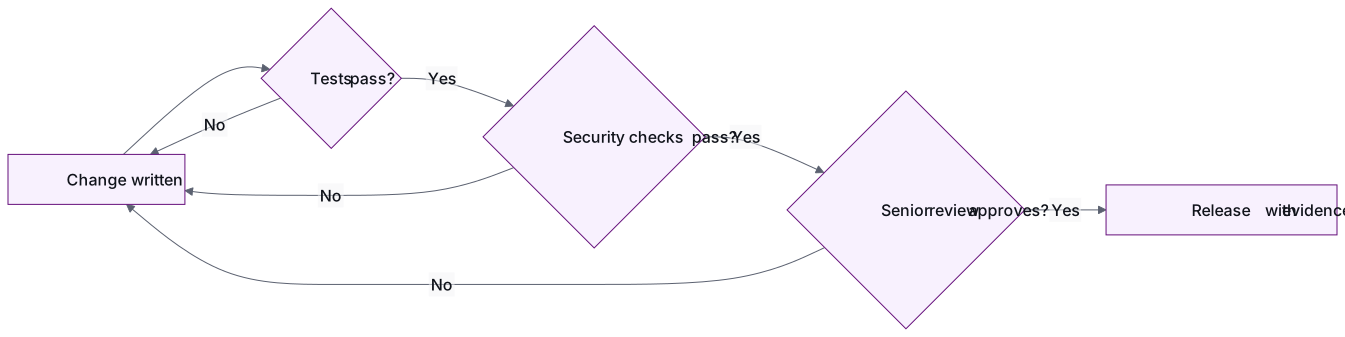
Every change must pass three gates before it ships: tested, secured and reviewed. This applies whether a person or an AI wrote it.
Each gate answers a different question:
- Tested: automated tests show the change works and hasn't broken anything that worked before.
- Secured: security checks show the change is safe, including the dependencies it pulls in.
- Reviewed: a senior engineer's review confirms the change is right for the system, not just syntactically valid.
These gates are mandatory, and the order matters. A change that fails a gate goes back to the author, whether that's an engineer or a model. Nobody gets to skip a check because a deadline is close.
Our Quality Engineering practice builds this system inside a client's own pipeline. It covers AI-generated tests that engineers review, code review gates, security and regression checks, and release evidence for every release. If you want to set this up yourself, our guide on how to verify AI-generated code before production walks through each gate.
The same rule applies when AI is part of the product itself:
- Generative AI features get an evaluation set built from real user questions. It runs on every prompt, model or retrieval change, so a regression shows up before users see it.
- AI agents get scoped permissions and a full audit trail, and a person approves every risky action.
How does quality show up in the way Calidad teams work?#
Quality is part of how each team is set up and how work moves. It isn't a testing phase at the end.
Four working beliefs run through our teams:
- We design before we scale.
- We automate before we expand.
- We validate early, not late.
- We own what we ship.
Most quality problems start with a hand-off, so our engineers work inside your team. They join your subject-matter experts in the same stand-ups and channels and work to the same goals. Your experts know the business, and our engineers know how to build it. Nothing gets lost passing through specs, tickets and middlemen.
On long-running Dedicated Teams, the rules are written down and agreed up front. They cover code review, tests, how AI tools are used, and the definition of done, and they are checked every sprint. A delivery lead is accountable for pace and quality. This matters because AI-assisted output varies from one person to the next, and review can easily become the bottleneck.
Here is how this differs from traditional outsourcing, based on our Why Calidad comparison:
| Traditional outsourcing | Calidad | |
|---|---|---|
| What you pay for | Hours and headcount | Agreed outcomes, in fixed-fee pods |
| Who does the work | Contractors on the other side of a hand-off | Engineers embedded with your experts |
| Quality | A testing phase at the end | Tests, security checks and review on every release |
| Use of AI | Ad hoc, tool by tool | Built into how every pod delivers |
| How you start | A long contract up front | A paid pilot, no long-term contracts |
What proof can you see before you commit?#
You get a paid pilot: one pod working on one outcome, with success criteria agreed up front. You judge the result on working software, not on a pitch.
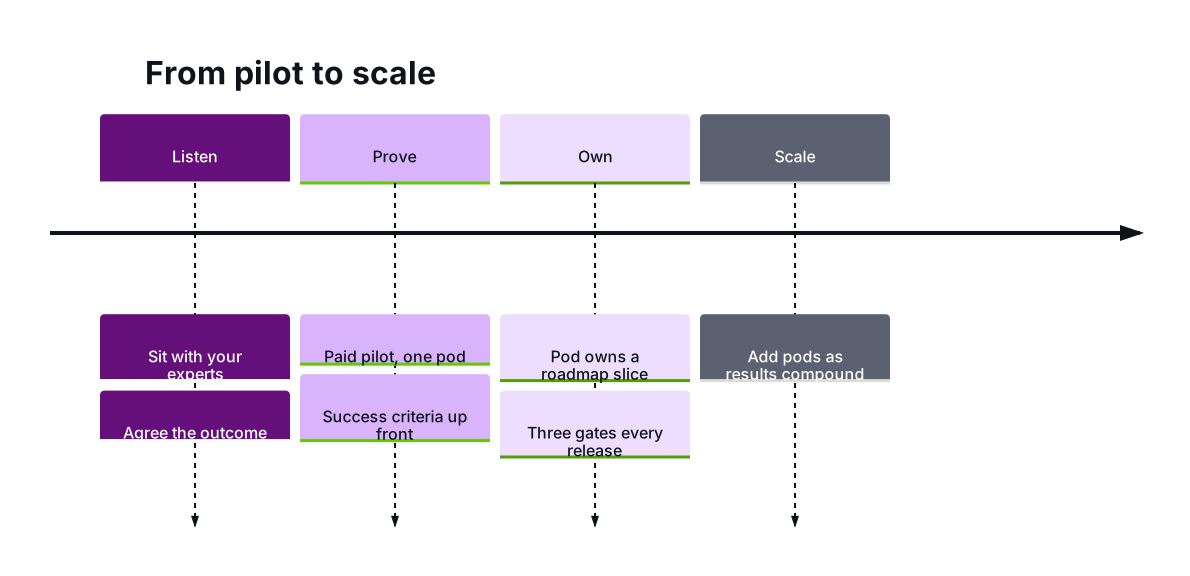
Every engagement follows the same four steps:
- Listen: our engineers start by sitting with your experts to learn the domain and agree on the outcome.
- Prove: the pilot runs, with AI doing much of the heavy lifting, and produces working software in days rather than weeks.
- Own: if the pilot meets its criteria, a dedicated pod takes ownership of a slice of your roadmap, with every release going through the same three gates.
- Scale: you add pods, capabilities or managed capacity only as results build up.
There are no long-term contracts. Clients stay because the work holds up, not because they're locked in. Our post on what a paid software vendor pilot needs explains how to scope the pilot and make the call to scale or stop.
Here is one example. An e-commerce platform expanding into new regions had growing release delays and inconsistent data flows. We started with a focused cloud and platform maturity assessment. Then we ran a consulting-led pilot with the client's own team to redesign the architecture and delivery workflows. The result was more predictable releases, stronger data governance and a foundation that can scale with the business.
Who is Calidad Infotech for?#
We work with CTOs, VPs of Engineering and product leaders at enterprises, product companies and Global Capability Centers (GCCs). Our clients are in the US, UK, Europe, Singapore and Africa. Our teams are in Ahmedabad and Bengaluru, India.
We work in five ways:
- Product Engineering Pods: a full product team that owns a slice of your roadmap.
- Quality Engineering: release gates for AI-written code.
- GCC Enablement: setting up a capability center in India one pod at a time.
- Platform Modernization: moving legacy systems to cloud-native platforms without downtime.
- Dedicated Teams: long-term engineers who work in your time zone.
Our consultants also advise on AI strategy, architecture, DevSecOps, cloud migrations, data governance and cloud costs, and then stay to build what they recommend.
Conclusion#
Calidad means quality, and we chose the name because it describes the part of software work AI hasn't made easy. AI made code cheap and fast to write. Making sure that code is correct, secure and safe to release still takes engineers who are accountable for it. Our three gates, embedded teams and pilot-first engagements are how we put that into practice.
If you're shipping more AI-written code and want proof that each release holds up, talk to an engineering lead →
Frequently asked questions
Is Calidad Infotech a testing company?
No. We're an AI-augmented software engineering company. We build products, platforms, data systems and AI features. Quality engineering is how every one of our pods ships work: tests, security checks and senior review on each release. It isn't a separate testing service.
Do your engineers use AI to write code?
Yes. AI is built into how every pod delivers, and that's where most of our speed comes from. Engineers stay accountable for everything that ships. A change written by AI goes through the same three gates as a change written by a person.
How does an engagement with Calidad start?
With a paid pilot: one pod, one outcome, and success criteria agreed before work begins. When you get in touch, an engineering lead replies within 24 hours and has a focused call with you to agree the outcome. There are no long-term contracts.
Where are Calidad's teams based, and can they work in our time zone?
Our engineering teams are in Ahmedabad and Bengaluru, India, and we work with clients in the US, UK, Europe, Singapore and Africa. Dedicated engineers join your team for the long term and work in your time zone, with a delivery lead accountable for the team.
How do you keep AI features inside our product reliable?
We treat an LLM feature like any other product feature: it gets a spec, a test suite and a budget. That means an evaluation set built from real user questions and run on every change, guardrails on inputs and outputs, and cost and latency targets for each request.
- software quality
- AI-generated code
- quality engineering
- Calidad Infotech
- release gates
Newsletter
Get new articles by email
A short monthly round-up of what we've written on engineering pods, quality and AI. No spam.
