
Cloud migration services should cover four things: an assessment of every workload, a strategy for each one (rehost, re-platform, re-architect or retire), a phased move with a tested rollback plan for every step, and checks on performance, security and data integrity before and after cutover. A good partner shows it can do this on one real workload before you sign for more.
This guide is for CTOs and VPs of Engineering comparing migration partners. It covers what a sound engagement includes, from assessment to cutover, and how to test a provider on real work. It also explains how our cloud migrations practice handles each stage.
What should cloud migration services actually include?#
A full engagement runs from the inventory through to running the new environment, not just the move itself. Look for these parts in any proposal:
- Readiness assessment. Applications, dependencies, owners and business priorities, mapped with the people who run the systems today.
- A strategy for each workload. Each workload gets its own decision. One label for the whole estate isn't a plan.
- A wave plan. AWS recommends that you organize each migration wave into phases with an expected duration, starting with a design phase where the target design is approved.
- A runbook and a rollback plan for every step.
- Checks throughout. Tests, security checks and data-integrity checks on every release, not one testing phase at the end.
- Cost guardrails in place before the first cloud bill arrives.
- Handover material. Runbooks, architecture records and release evidence your team can use without the vendor.
Be careful with proposals that offer "lift and shift everything" with one cutover date and no rollback section. That's a bet, not a plan.
Cloud migration consulting vs a migration delivery team: which do you need?#
Hire consulting when the big decisions are still open, and a delivery team once they're made. Most enterprises need both, and it works best when the same people do both.
| Migration consulting | Migration delivery team | |
|---|---|---|
| Main output | Assessment, workload strategies, target architecture, wave plan | Migrated workloads, pipelines, runbooks, release evidence |
| Fits when | You don't yet know what to move, in what order, or why | The plan is agreed and you need engineers to carry it out |
| Typical risk | A plan that looks good on slides but no one can build | Fast moves that skip the hard questions about architecture or data |
| Ask them | "Who will build what you recommend?" | "Who approved the plan you're working from?" |
When consulting and delivery come from different firms, the gap between them is where schedules slip. Our consultants are engineers who stay to build what they recommend. That way the advice and the delivery stay aligned, and every recommendation comes with a path to production.
How do you assess which workloads to rehost, re-platform or re-architect?#
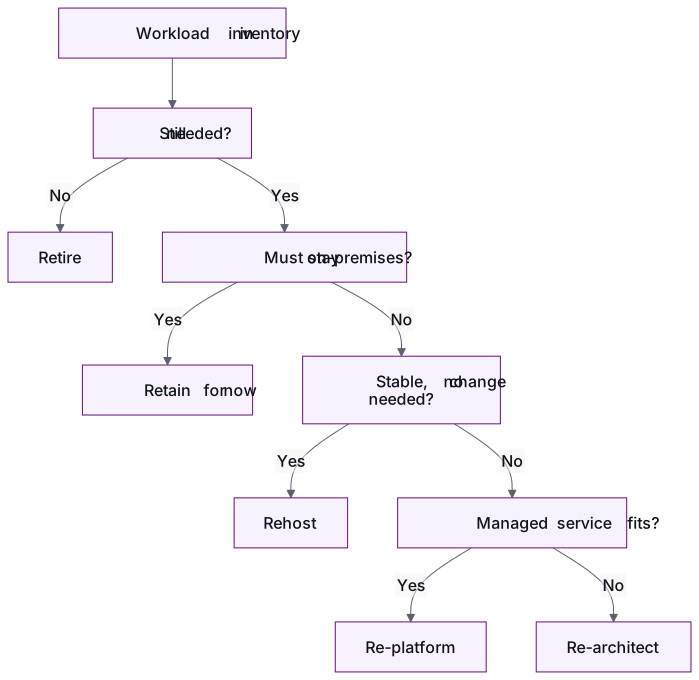
Score each workload on its business driver, how stable it is, and how much change the cloud target requires. Then pick the least invasive strategy that still meets the goal.
The major cloud frameworks agree on the options, even if they name them a little differently. AWS lists seven strategies: retire, retain, rehost, relocate, repurchase, re-platform, and refactor or re-architect. Microsoft's Cloud Adoption Framework sorts each workload into retire, retain, rehost, re-platform, refactor, re-architect, rebuild or replace.
Here's how to apply them:
- Retire anything nobody uses. It's the cheapest migration there is.
- Retain workloads that must stay on-premises for now, such as those with data residency limits or hardware dependencies.
- Rehost stable, compatible workloads that don't need modernizing soon. Microsoft lists stability, low migration risk and no immediate modernization need as signs that rehosting fits.
- Re-platform when a managed service can replace something you run yourself. AWS notes that this reduces cost and improves performance by moving to managed or serverless services or from VMs to containers.
- Re-architect only when components need to scale independently or the application has to be broken up. AWS calls refactoring the most complex and costly strategy and advises using it in large migrations only when no other option is acceptable.
If a large part of the estate needs re-architecting, treat that as a separate modernization project. Our Platform Modernization service moves critical legacy systems onto cloud-native platforms while the business keeps running.
What does a phased migration with a rollback plan for every step look like?#
Move one low-risk workload first to prove the runbook. Then migrate in waves, shifting traffic gradually so that any step can be reversed.
AWS's cutover guidance describes a phased (canary) approach. A share of users goes to the migrated servers while the existing capacity keeps running. Rolling back usually takes only a change to a load balancer, a DNS rule or a policy. AWS says this approach is most common for business-critical production workloads. The simpler all-at-once cutover suits development and test environments that can tolerate some downtime.
A workable rollback plan covers:
- Triggers: the error rates, latency limits or data mismatches that start a rollback automatically.
- A decision owner: the one person who can call it, named in advance.
- A path back for the data: a final backup and sync before cutover. AWS recommends taking that backup so it's there in an emergency.
- A time limit: how long the old environment stays warm after cutover.
- A rehearsal: a rollback that has never been tested is only a hope.
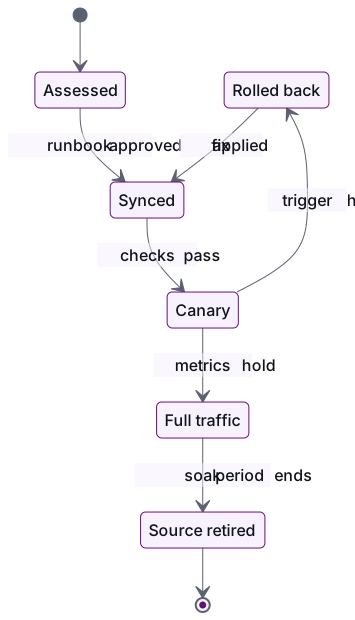
Our own approach follows this pattern. We plan with your experts, move a low-risk workload first so the runbook is proven before anything critical moves, migrate the rest in controlled phases, and keep a rollback plan for every step.
How should security, testing and release checks be built into a migration?#
Treat every migration change as a release that has to pass the same gates: tests, security checks and senior engineer review. That includes infrastructure code, configuration, data syncs and application edits.
Migrations fail quietly when nothing is checked along the way. In practice, that means:
- Record a baseline on the source system before you move: response times, throughput and key business transactions. Without it, "it's slower in the cloud" can't be settled.
- Check data integrity at every sync and at cutover, using record counts, checksums and reconciliation of critical tables.
- Scan infrastructure code on every pull request, and review permissions and network exposure before anything goes live.
- Apply the same gates to AI-written code. Conversion scripts and Terraform written by AI assistants get tests, security checks and a senior engineer's review, like any other change.
- Keep release evidence: what was tested, what passed and who approved it. Auditors and incident reviews will both ask for it.
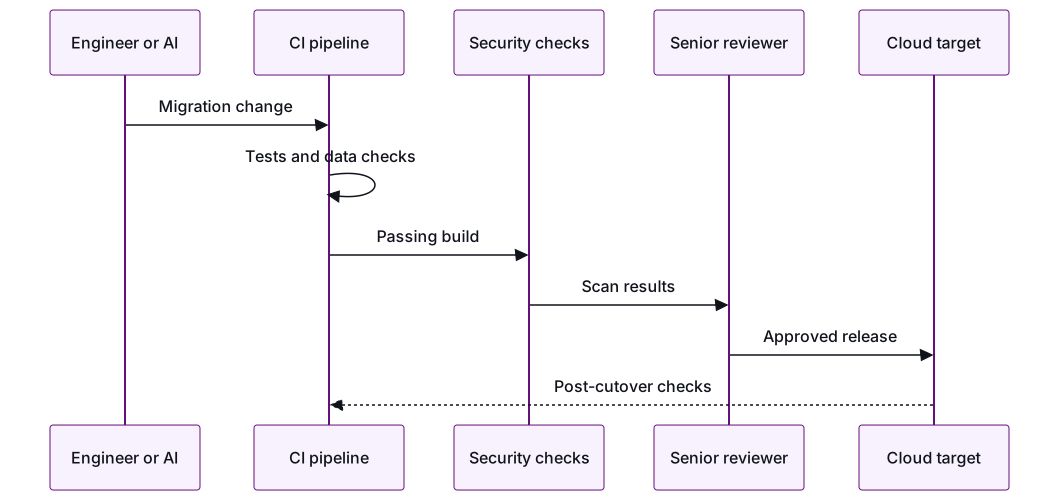
In our migrations, tests, security checks and data-integrity checks run on every release, both before and after cutover.
Which questions separate strong cloud migration providers from weak ones?#
Ask questions that force specifics. Weak providers answer with tool names and slogans, while strong ones answer with thresholds, owners and evidence.
- "Show me a rollback plan from a past migration." A strong answer names triggers, owners and how the data gets back.
- "How do you decide rehost versus re-architect?" Listen for criteria for each workload, not one default for everything.
- "Which workload would you move first, and why?" It should be low-risk and representative, never the crown jewels.
- "What do you check on every release during the move?" Expect tests, security scans and data integrity, with evidence kept.
- "Who reviews AI-generated migration code?" There should be a named senior engineer, not "the tool checks it."
- "Who on your side is accountable if a wave slips?" It should be a person, not a ticket queue.
- "How do we exit if this isn't working?" Long lock-in contracts suggest they don't expect you to stay by choice.
How do you keep cloud costs from rising after the move?#
Set up cost ownership and guardrails during the migration, not after the first surprising bill.
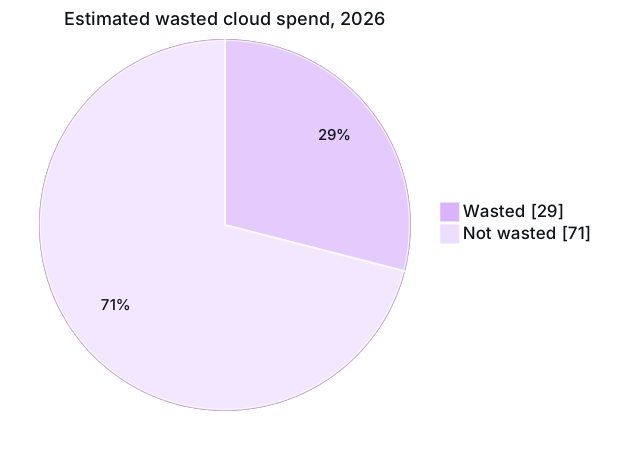
Waste is common. In Flexera's 2026 State of the Cloud Report, respondents estimated that 29% of their IaaS and PaaS spend is wasted. That figure had fallen for five years and has now risen again, which Flexera links to cost complexity from AI and new services. Five years earlier the estimate stood at 30%, so more cloud experience on its own hasn't fixed the problem.
Build these controls into the migration:
- Tag every resource by team, product and environment when it's created, and enforce the tags in infrastructure code.
- Size resources from cloud usage, not on-premises specs. Resize after the soak period, once real usage is visible.
- Schedule the source shutdown. Paying for both environments for months is a common overrun.
- Set budgets and alerts per team so spend has an owner.
- Buy commitments only after usage settles.
- Track AI and LLM costs separately. We cover this in FinOps for SaaS: cutting cloud and LLM costs.
How can a paid pilot prove a migration partner before you commit?#
Give the partner one real, low-risk workload and agree success criteria in advance. Then judge the result on working software, not on a proposal.
Useful pilot criteria for a migration:
- The workload runs in the cloud, with a rollback that has been rehearsed.
- Test, security and data-integrity evidence is attached to every release.
- The runbook can be reused for the next wave.
- Resources are tagged and the cost is visible.
- Your engineers understand what was built and could run it.

Our engagements start with an assessment, followed by a paid pilot: one pod, one outcome and success criteria agreed up front, with no long-term contract. In one case, an e-commerce platform scaling across regions had growing release delays and inconsistent data flows. A maturity assessment and a consulting-led pilot led to more predictable releases, stronger data governance and a foundation it could scale on. For pilot scoping in more detail, see what a paid software vendor pilot needs.
Conclusion#
A good cloud migration is mostly about discipline. Assess every workload, choose the least invasive strategy that meets the goal, and move in phases with a rehearsed rollback for every step. Check performance, security and data on every release, and set cost guardrails before the bill arrives. Then test the partner on one real workload before committing to the whole estate.
Planning a migration? Talk to an engineering lead →
Frequently asked questions
How long does a cloud migration take?
It depends on how many workloads you have and the mix of strategies. Rehosting stable workloads is quick, while re-architecting takes much longer. Moving one representative workload first gives you a measured pace to plan the remaining waves, rather than a guess.
Can we migrate to the cloud without downtime?
Often you can. A phased cutover sends a share of traffic to the migrated system while the original keeps running, so you can switch back with a load balancer or DNS change. Some systems still need a short freeze for the final data sync, and that window should be planned and rehearsed.
Should we refactor applications during the migration?
Only where you have to. AWS calls refactoring the most complex and costly migration strategy and advises it in large migrations only when other options won't work. Many teams rehost or re-platform first, then modernize specific components once they're running in the cloud.
Will moving to the cloud reduce our infrastructure costs?
Not automatically. Respondents to Flexera's 2026 State of the Cloud Report estimated that 29% of IaaS and PaaS spend is wasted. Savings come from tagging, sizing resources from real usage, shutting down source environments on schedule and giving each team's spend an owner.
What does Calidad Infotech deliver in a cloud migration engagement?
A readiness assessment, a migration strategy aligned to business priorities, phased moves with a rollback plan for every step, and automated testing and release checks throughout. Tests, security checks and data-integrity checks run on every release before and after cutover. Engagements start with an assessment and a paid pilot, with no long-term contracts.
What are workload migration services?
Workload migration services move individual applications, databases and servers from one environment to another, such as from a data center to the cloud or between clouds. A good service assesses each workload, picks a strategy for it, moves it in phases with a tested rollback, and checks performance, security and data after cutover.
- cloud migration
- cloud migration services
- migration strategy
- cloud architecture
- FinOps
Newsletter
Get new articles by email
A short monthly round-up of what we've written on engineering pods, quality and AI. No spam.
