
A data lake is a storage architecture: one central place to keep raw and structured data at any scale. Data mesh is an operating model: business domains own their data and publish it as products on a shared self-serve platform under federated governance. They answer different questions, so an enterprise adopting mesh usually still runs a lake or lakehouse underneath.
What is the difference between a data mesh and a data lake?#
A data lake decides where data lives. Data mesh decides who owns the data and how it is shared.
AWS describes a data lake as a central repository for structured and unstructured data at any scale. You store the data as it arrives, without structuring it first. A lakehouse builds on that idea. The CIDR 2021 lakehouse paper describes it as a platform built on open data formats such as Apache Parquet, with first-class support for machine learning and warehouse-level performance.
Data mesh is not a storage design. Zhamak Dehghani proposed the concept in 2019, and it rests on four principles:
- Domain ownership. The business domain that produces the data is accountable for it.
- Data as a product. Each dataset is discoverable, documented and trustworthy.
- Self-serve data platform. Shared infrastructure lets domain teams publish data without filing a ticket with a central team.
- Federated computational governance. A small set of global rules is set together and enforced by the platform.
| Data lake / lakehouse | Data mesh | |
|---|---|---|
| What it is | Storage and compute architecture | Ownership and operating model |
| Question it answers | Where does data live and how is it queried? | Who owns each dataset, and how is it shared? |
| Who owns data quality | Usually a central data team | The domain that produces the data |
| Governance | Central rules, central enforcement | Global rules set jointly, enforced by the platform |
| Typical failure | Central team becomes a bottleneck; nobody owns tables | Domains publish inconsistent data; governance splinters |
| Fits best when | Few domains, one team can keep up | Many domains, and the central team can't keep up |
Is data mesh a replacement for a data lake or lakehouse?#
No. Data mesh usually runs on top of a lake or lakehouse rather than replacing it.
The big cloud providers' reference designs show this. Microsoft's Cloud Adoption Framework describes its simplest data mesh deployment as a single data landing zone. Resource groups separate the domains and their data products, and standard services such as Azure Data Lake Store are shared by all of them. Google Cloud's data mesh reference keeps the data in BigQuery and BigLake. It adds federated access layers, and Dataplex provides central administration and governance.
So "mesh vs lake" is really a choice between central ownership and domain ownership. You can use the same physical platform either way. The real decision is about people, accountability and funding, not file formats.
When does a centralized data lake or lakehouse make more sense?#
A centralized lake or lakehouse makes more sense when one data team can still meet demand and the business has only a few data-producing domains.
Stay centralized if most of these are true:
- The central team isn't the bottleneck. Requests for new datasets are delivered within a timeframe the business accepts.
- Domains don't have data engineers. Handing ownership to teams that can't maintain pipelines moves the backlog without shrinking it.
- Consumers are mainly BI and reporting. One team defining metrics once is simpler than coordinating many teams.
- Regulation dominates. In one interview study of data mesh implementations, practitioners named the move to federated governance as the main challenge. They also reported limits on automating it for security, regulatory and privacy needs.
- The basics aren't in place yet. Reliable ingestion, a catalog and tested transformations come before any discussion of ownership.
A lakehouse also fixes a common structural problem. The CIDR paper's authors note that loading data into a lake and then again into a warehouse adds complexity, delays and new failure modes. Removing that second copy is often worth more than reorganizing teams.
When is an enterprise ready for data mesh, and what does it require?#
An enterprise is ready for data mesh when the central data team has become the constraint and domain teams have the skills, staff and reason to own data products.
Signals that you're ready:
- Data requests wait in a central queue, while domain experts understand the data better than the people building the pipelines.
- Several domains already run their own engineering teams in production.
- Problems often come from upstream: a source team changes a field and downstream reports break without anyone noticing.
Prerequisites:
- Data engineers inside domains, or a plan to embed them.
- A self-serve platform with templates for ingestion, transformation, testing and publishing.
- Named data product owners who answer for quality and service levels.
- Federated governance with a few global policies that are enforced in code, not left in wiki pages.
- A change-management plan. A systematic review of data mesh literature found that the move challenges established processes and hierarchies. It recommends an enabling team that helps domains onboard and adopt good practices.
Be honest about maturity. According to Atlan's summary of Gartner research, Gartner's 2021 survey found only 18% of organizations had the governance maturity needed to adopt data mesh successfully.
How do governance, ownership and lineage work in each model?#
In a lake, a central team sets the rules and often owns the data. In a mesh, domains own their data, and jointly agreed global rules are enforced by the platform.
| Concern | Centralized lake / lakehouse | Data mesh |
|---|---|---|
| Ownership | Central team, sometimes with business stewards | Business owner and technical owner in each domain |
| Quality | Tests in central pipelines | Tests and service levels the domain publishes for its data products |
| Producer–consumer agreements | Often implicit | Explicit data contracts |
| Lineage | Traced through the central pipelines | Traced across domains through a shared catalog |
| Access policy | Set and applied centrally | Global classification rules, applied by the platform |
Both models need the same basics: owners written down, defined quality and traceable lineage. Mesh simply makes them non-negotiable. Data contracts make producer–consumer agreements explicit. A data contract pairs a schema with quality rules and service levels, and the Linux Foundation's Bitol project publishes an open standard for them (ODCS).
Our data governance and MDM practice works the same way in either model. Every critical entity and dataset gets a named business owner and technical owner. Data contracts and quality SLAs are enforced in CI, so a broken contract fails the producer's build before it corrupts a consumer's report. Classification, lineage and access policies decide which data models and AI agents may use.
How does each approach affect feeding analytics, products and AI?#
A lakehouse gives you one place to compute and serve data. Mesh gives every dataset a clear owner. AI workloads need both.
- Analytics. The biggest risk is that every dashboard computes revenue its own way. A semantic layer defines each metric once, and BI tools, apps and agents all reuse that definition. This matters even more in a mesh, where many teams publish data.
- Product features. Freshness should follow the consumer: seconds for an in-product feature, hours for finance reporting. Domain-owned data products can publish these service levels explicitly.
- AI and machine learning. The lakehouse design was intended to give machine learning first-class access to the same governed data as BI. Mesh adds accountability. When someone asks what data a model used and who approved it, a data product with an owner, a contract and lineage can answer.
Our data platforms practice treats the platform as software, with version control, tests, CI and an on-call owner. That is also what a mesh's self-serve platform needs. Domain teams can only own data products if publishing one is a routine, tested release.
Can you move from a data lake toward data mesh gradually?#
Yes. The lowest-risk path keeps the lake or lakehouse and changes ownership one domain at a time.
- Make the platform self-serve. Turn ingestion, transformation-as-code, testing and catalog registration into templates any team can use.
- Name owners for critical datasets. Do this before moving any work. Unowned tables stay unowned after a reorganization.
- Pick one domain. Choose a domain that has engineers and a clear downstream consumer. It publishes one or two data products with contracts.
- Automate a few global policies. Start with classification, access rules and shared identifiers so data from different domains can be joined.
- Expand only on evidence. Add the next domain once the first meets its service levels. Over time, the central data team becomes the platform team.

Some enterprises stop partway and that's fine. A hybrid is a legitimate end state: domain-owned data products for the few domains that need them, with central ownership for the rest.
How do you test the choice with a pilot before a full rollout?#
Run a time-boxed pilot with one domain, one data product and one real consumer, and agree the success criteria before work starts.
Criteria worth agreeing up front:
- Lead time. Days from a consumer's request to a usable, documented dataset, compared with the current central queue.
- Upstream catches. Breaking changes caught by contract checks in CI rather than reported by consumers.
- Service levels. Freshness and quality targets met throughout the pilot.
- Adoption. The consumer uses the data product instead of a side extract.
- Domain effort. Hours per week the domain team spends running the product, and whether that's sustainable.
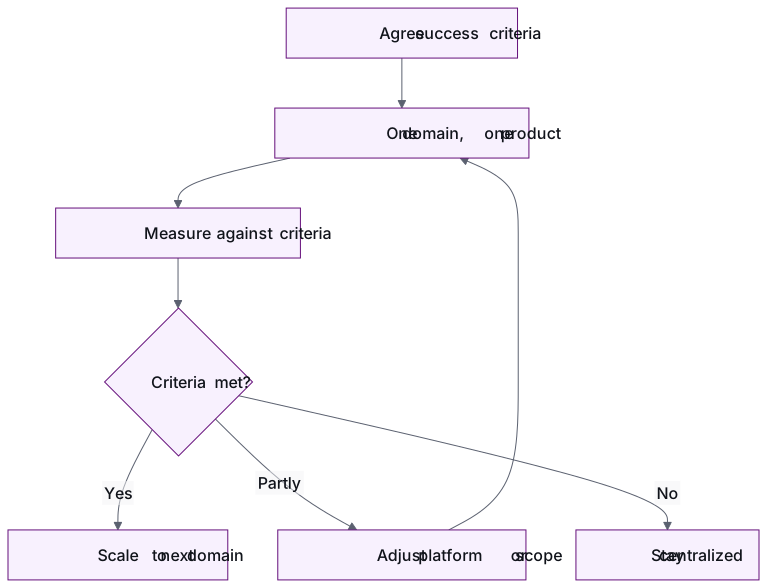
If the domain can't keep its product healthy without heavy central support, that is useful evidence too. It means the platform or the domain's staffing isn't ready yet. Our guide to scoping a paid pilot covers how to set criteria and make the scale-or-stop call. We run engagements the same way: one pod, one outcome and success criteria agreed before the work begins.
Conclusion#
Data lake and data mesh are not competing options. A lake or lakehouse is where the data lives. Mesh is how ownership and governance are organized around it. Stay centralized while one team can keep up. Move toward mesh when the central queue becomes the constraint and domains can own their data. Make that move one domain at a time, and test it with a pilot that has agreed criteria.
Want to test the model on one domain before reorganizing the rest? Talk to an engineering lead →
Frequently asked questions
Is a data lakehouse the same as a data mesh?
No. A lakehouse is a technical architecture that combines lake storage with warehouse features such as schemas, governance and fast SQL. Data mesh is an organizational model for who owns data and how it's shared. A mesh often runs on a lakehouse.
Do we need a new platform to adopt data mesh?
Usually not. Microsoft's and Google Cloud's reference designs both put data mesh on shared storage and services. What you usually need to add is self-serve tooling, a catalog and policy enforcement so domain teams can publish data products without central tickets.
What is a data product in a data mesh?
A data product is a dataset that a domain publishes for others to use. It has a named owner, documentation, quality checks and agreed service levels. It is usually backed by a data contract that defines its schema and guarantees, so consumers can depend on it like an API.
How long should a data mesh pilot take?
Keep it short enough to protect the budget but long enough to cover real changes. That means at least one upstream schema change and several refresh cycles of the data product. The fixed scope matters more than the calendar: one domain, one product, one consumer and criteria agreed before work starts.
Can data mesh work in regulated industries?
It can, but governance is the hardest part. Practitioners report that automating federated rules for security, privacy and regulatory needs is difficult. Many regulated enterprises keep classification and access policy central and enforced by the platform, while giving domains ownership of quality and content.
- data mesh
- data lake
- lakehouse
- data governance
- data platforms
- data architecture
Newsletter
Get new articles by email
A short monthly round-up of what we've written on engineering pods, quality and AI. No spam.
