
A dedicated development team is a stable group of engineers who stay with your product, follow one set of standards and report to one lead. Freelancers are individuals you hire for a task. If your product has a continuous roadmap, a dedicated team usually gives you better continuity, accountability and security. Freelancers suit short, well-bounded work.
What is the real difference between a dedicated team and freelancers?#
The main difference is who holds the context and who answers for the result. With freelancers, you do. With a dedicated team, the team does.
Both models can produce good code, and individual freelancers are often very skilled. The differences show up over months, not in a single sprint:
| Criterion | Freelancers | Dedicated team |
|---|---|---|
| Continuity | Engagements end when the task ends; context leaves with the person | Same engineers over time, so knowledge of your system builds up |
| Accountability | Each person answers for their own task | A lead answers for pace, quality and team health |
| Code ownership | Spread across individuals; parts often end up with no owner after they leave | The team owns modules and keeps them up to date |
| Security and access | One contract, one set of credentials and one offboarding per person | One agreement, one access policy, one offboarding process |
| Management overhead | You source, scope, review and combine everyone's work | A delivery lead handles day-to-day coordination |
| Standards | Each contributor brings their own habits and tools | Shared review, testing and definition-of-done rules |
| Flexibility | Very high for one-off needs | Grows or shrinks with the roadmap, with notice |
When are freelancers the right call for a product company?#
Freelancers are the right call when the work is short, clearly specified and kept apart from your core codebase.
Good fits:
- A landing page or marketing site build. It needs little product context, has a clear finish line and its own repository.
- A one-off data migration script. Bounded, easy to test against known outputs, and thrown away afterwards.
- Ongoing marketing site upkeep. Continuous but low-context. A freelancer on retainer works well.
- A short architecture or performance review. This needs deep context, so pair a senior specialist with your own lead rather than letting them work alone.
Work that is ongoing and needs deep product context belongs to a team: the core product roadmap, or a payments integration you'll maintain for years.
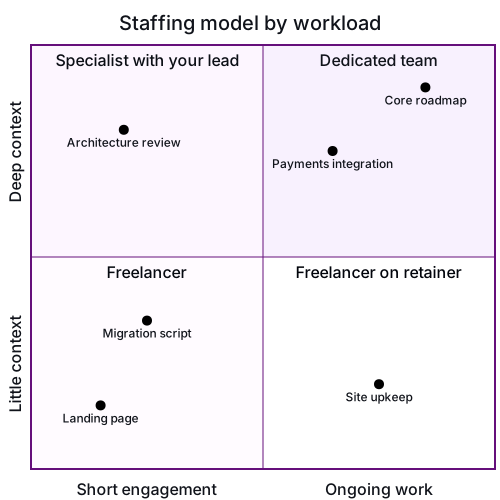
A simple decision rule by stage:
- Pre-product or prototype stage: freelancers or a short discovery engagement. Speed matters more than continuity, and much of the code may be thrown away.
- Live product with regular releases: a dedicated team for the core roadmap. Use freelancers only for bounded side work.
- Several roadmap streams at once: teams that each own an outcome, so no single manager becomes the bottleneck.
What happens to code quality and ownership when contributors rotate?#
When contributors rotate, the knowledge of why the code is written the way it is leaves with them, and the parts they wrote stop having an owner.
You can spot the symptoms in any codebase built by a series of short engagements:
- Modules whose only author is gone, so nobody wants to touch them.
- Three ways of doing the same thing (error handling, data access, state management), one per contributor.
- Tests that cover the happy path from the original ticket and nothing added since.
- Reviews that check "does it work?" but not "does it fit?", because the reviewer is new too.
You can reduce this with either model. Require tests and review in the pipeline. Record architecture decisions where the code lives. Name an owner for every module. A dedicated team makes those controls easier to keep, because the same people meet the consequences of their own decisions.
This is how our Dedicated Teams work. Engineers join your product for the long run, in your time zone. You interview every one before they start. A delivery lead owns onboarding and is your single point of accountability. Rules for code review, tests, AI tool use and definition of done are agreed up front and checked every sprint.
How do security, access and IP compare between the two models?#
Both models can be run securely. With a team you manage one contract, one access policy and one offboarding process. With freelancers you repeat each of those for every person.
The standard to apply in both cases is least privilege, which NIST defines as restricting access to the minimum necessary to accomplish assigned tasks. In practice, every contributor's access goes through the same lifecycle:
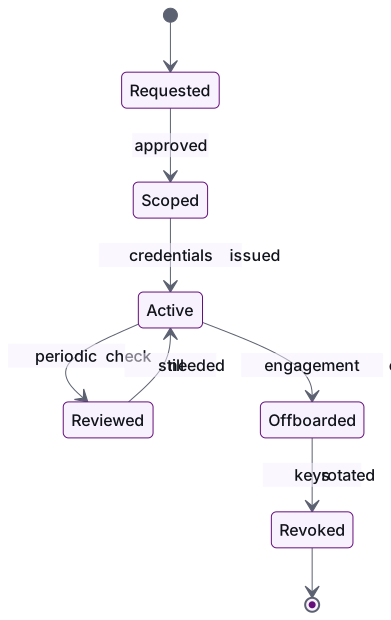
With six freelancers who start and finish on different dates, you run this lifecycle six times, on six schedules. The step that usually gets missed is the last one: removing repository access, cloud roles and shared secrets on the day the work ends. With a team, offboarding runs through one process with one accountable party.
IP needs explicit attention with freelancers. The US Copyright Office's Circular 30 explains that a commissioned work by a non-employee is "made for hire" only if it falls into specific statutory categories and both parties sign a written agreement. Most software doesn't fit those categories, so ownership of a freelancer's code usually depends on a signed assignment of copyright. Other countries have different rules, so ask your counsel.
Checklist for either model:
- A signed agreement that assigns IP to you before work starts.
- Access scoped per repository and per environment, with no shared admin accounts.
- Secrets kept in a vault, never sent in chat.
- A dated access review, and revocation as an offboarding step.
- For a vendor: confirm the master services agreement covers IP, confidentiality and who the engineers are employed by.
Who manages the work, and how much of your time does it take?#
With freelancers, you or your engineering manager do the managing. With a managed dedicated team, a delivery lead handles day-to-day coordination, and you set priorities and judge the outcomes.
These jobs land on you with a group of freelancers:
- Sourcing and vetting each person, and replacing them when they leave.
- Writing tickets detailed enough for someone without context.
- Reviewing every pull request yourself, because nobody else knows the whole system.
- Combining work from people who never talk to each other.
- Contracts, invoices, time zones and access, multiplied by the number of people.
In a managed team, much of that shifts to the delivery lead and the team's own review process:
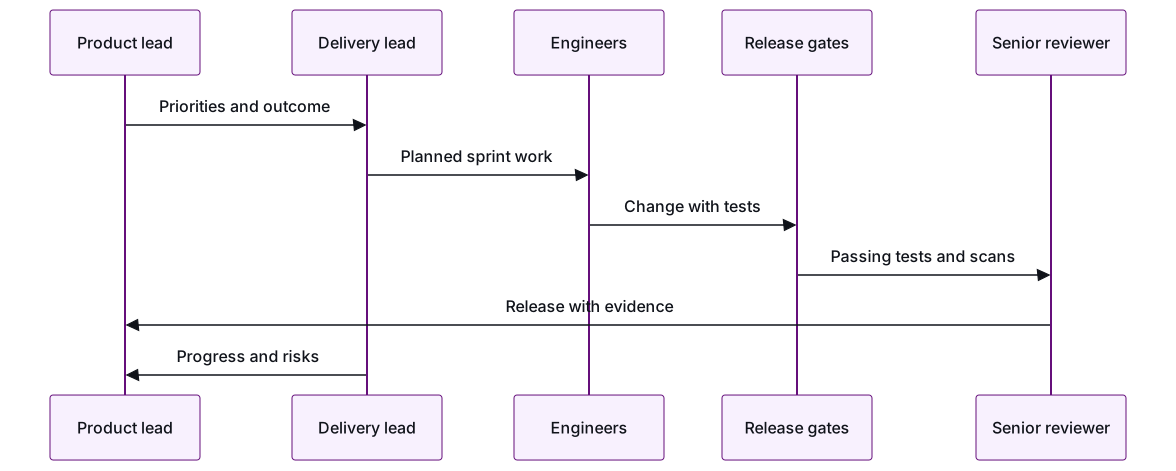
Your time goes into the two ends of that flow: deciding what matters and checking that it shipped. The handoffs in between aren't your job any more.
How does AI-assisted coding change the freelancer vs team trade-off?#
AI makes each person's output faster and cheaper. That makes review and verification the bottleneck, which favours a team with one shared review standard.
The data points the same way:
- Google's 2025 DORA report found 90% of respondents use AI at work. AI adoption now correlates with higher delivery throughput, but it still has a negative relationship with delivery stability.
- In the Stack Overflow 2025 Developer Survey, more developers distrust the accuracy of AI tools (46%) than trust it (33%).
- Veracode's GenAI Code Security Report found AI-generated code introduced risky security flaws in 45% of tests.
Now picture five freelancers, each with their own AI assistant, prompts and idea of "done". You get much more code, but each piece has been checked to a different standard. The fix isn't to ban AI. It's to make every change, from a person or a model, pass the same gates.
Our engineering standard has three: tests prove a change works, security checks prove it's safe, and a senior engineer's review proves it's right. Nothing ships without all three. For a practical guide to setting up those gates, see how to verify AI-generated code before production.
How can you test a dedicated team before committing long-term?#
Run a paid pilot: one team, one real outcome, success criteria agreed in writing, and a decision date.
- Pick one outcome from your real roadmap. Not a toy project. It should touch your codebase, your pipeline and your domain experts.
- Write the success criteria first. For example: changes merged through your gates, defects that escape to production, and how much of your own time the work took.
- Interview the people who will do the work. Not just the person selling it.
- Grant scoped access using the lifecycle above, so offboarding is clean whatever you decide.
- Decide at the agreed date: scale, adjust or stop.
This is how we start every engagement: a paid pilot with one pod, one outcome and success criteria agreed up front, judged on working software, with no long-term contract. If it works, a dedicated team can grow into one of our Product Engineering Pods, a full team that owns a slice of your roadmap from first commit to production. For more detail on structuring the trial, see what a paid software vendor pilot needs.
Conclusion#
Freelancers are a good tool for short, bounded, low-context work, and most product companies will keep using them. The core roadmap is different. It needs people who stay, standards everyone shares, access you can control and someone who answers for every release. That matters more now that AI writes so much of the code. Start with a pilot, measure it against criteria you wrote down in advance, and only then decide whether to scale.
Weighing a dedicated team for your roadmap? Talk to an engineering lead →
Frequently asked questions
Is a dedicated development team more expensive than freelancers?
Hourly rates are only part of the cost. Add the time you spend sourcing, scoping and reviewing, the onboarding each new person needs, rework from inconsistent standards, and the cost of replacing someone mid-project. The fairest comparison is cost per shipped and verified outcome, which a paid pilot lets you measure directly.
Can I use freelancers and a dedicated team together?
Yes, and many product companies do. Let the team own the core product and send bounded side work to freelancers, such as a marketing site or a one-off script. Require all freelancer changes to pass the same tests, security checks and review as the team's, and give freelancers access scoped to what their task needs.
Who owns the code a dedicated team writes?
That depends on your contract, not the staffing model. Check that the master services agreement or statement of work assigns IP to you, and covers confidentiality and what happens at the end of the engagement. With freelancers, check for a signed IP assignment, because under US law commissioned software usually isn't automatically yours.
What happens if an engineer on a dedicated team leaves?
Ask any vendor how they handle replacement and handover before you sign. In a well-run team, the impact is smaller than losing a freelancer. Modules have shared owners, review spreads knowledge across the team, and a delivery lead owns onboarding the replacement. Your own engineers shouldn't have to do it.
How long should a pilot with a dedicated team run?
Long enough to ship real changes through your own pipeline and see how the team handles review feedback and an unplanned problem. Set the decision date and success criteria before work starts, so the result is judged on evidence rather than impressions. Keep the scope to one outcome, so the result is clear either way.
- dedicated teams
- staff augmentation
- product engineering
- software outsourcing
Newsletter
Get new articles by email
A short monthly round-up of what we've written on engineering pods, quality and AI. No spam.
