
To evaluate a software outsourcing company in India, check evidence instead of taking claims on trust. Inspect a real repository and its pull requests. Watch a pipeline run its tests and security scans. Find out who reviews AI-written code, and get working-hours overlap in writing. Then run a short paid pilot, with success criteria agreed in advance, before you sign any long contract.
This checklist is for CTOs and VPs of Engineering in the US, UK, Europe and Singapore who are choosing between Indian engineering partners. It covers assessing a vendor, not hiring a team. Every step asks for something you can see, run or measure.
What should you check before shortlisting an Indian engineering partner?#
Before the shortlist, check whether a vendor will show you real evidence. Polished pitches don't tell you that.
Use the first call to screen on six points:
- Who does the work. Will you meet and interview the engineers who will be on your project, or only a sales lead?
- What you pay for. Is the price based on hours and headcount, or on agreed outcomes?
- Access to evidence. Will they walk you through a real repository, pull request history and pipeline under NDA?
- Security baseline. Can they map their practices to a recognised framework?
- Working hours. Which hours will named engineers work, in your time zone?
- Exit terms. Can you start small and leave without a penalty if the work doesn't hold up?
Certificates and case studies are fine for screening, but they prove little about the code you will receive. Proof gets stronger the closer it is to real work. That's also why it takes more of your effort to check.
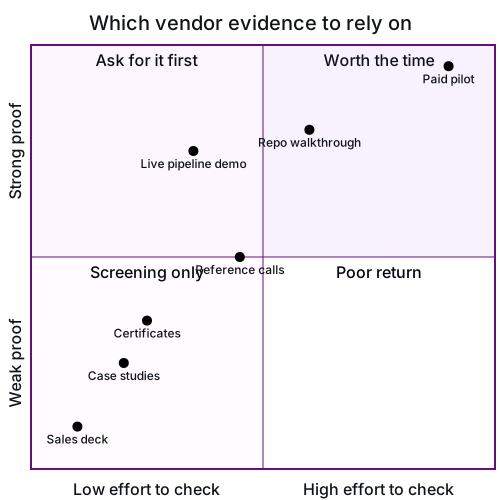
How do you assess code quality without taking the vendor's word for it?#
Look at real code and real history, chosen by you, not by the vendor.
- Ask for a repository walkthrough. The vendor's lead engineer should share their screen and open a recent pull request that you pick. Check how big it is, whether tests changed along with the code, and whether reviewers left real comments or just a quick "LGTM" ("looks good to me").
- Look at reverts and hotfixes. Ask how many changes were rolled back last quarter and why. If the vendor has no answer, nobody is measuring it.
- Ask for delivery metrics. The four DORA metrics are deployment frequency, change lead time, change failure percentage and failed deployment recovery time. A vendor that tracks them will show you trends. A vendor that doesn't will give you adjectives.
- Watch a small live change. Have an engineer add a validation rule or fix a small bug while you watch. You'll learn more from 30 minutes of real work than from a capability deck.
What security practices and review gates should a vendor show you?#
A vendor should show you which checks block a merge, not just list the tools it owns.
As a common reference, use NIST SP 800-218, the Secure Software Development Framework (SSDF). SSDF practices fall into four groups: prepare the organisation, protect the software, produce well-secured software, and respond to vulnerabilities. Ask the vendor to show where each group happens in their workflow.
Then check that the gates are enforced in the repository settings, not left to habit. On GitHub, for example, a protected branch with required status checks means all required checks must pass before anyone can merge into it. Ask to see the settings screen.
| Gate | What to ask for | Red flag |
|---|---|---|
| Automated tests | Required test check on the main branch | Tests run "nightly" or "before release" |
| Static analysis and secrets scanning | Scan results on a recent pull request | Scans run but never block a merge |
| Dependency checks | How new packages are approved | Any engineer can add any package |
| Human review | Who can approve, and whether self-approval is blocked | Authors merge their own changes |
| Vulnerability response | Last vulnerability found and how long the fix took | No record of past incidents |
If you sell software to the US federal government, this matters even more. Federal agencies require software producers to sign the CISA Secure Software Development Attestation Form, and your CEO signs it. A vendor's weak practices become your attestation problem.
How much time-zone overlap do you actually need, and how do you verify it?#
Aim for three to four shared working hours a day, and get the named engineers' hours written into the contract.
India runs on a single time zone, UTC+05:30, with no daylight saving. Overlap with Europe and the US therefore shifts by an hour whenever your clocks change. Here is the overlap if the vendor's engineers keep a standard 09:00–18:00 IST day and your team works 09:00–18:00 local time:
| Your location | Overlap (your winter time) | Overlap (your summer time) |
|---|---|---|
| Singapore | 6.5 hours | 6.5 hours (no DST) |
| Central Europe | 4.5 hours | 5.5 hours |
| UK | 3.5 hours | 4.5 hours |
| US East Coast | 0 hours | 0 hours |
| US West Coast | 0 hours | 0 hours |
For US teams, overlap only exists if engineers shift their day. A 13:00–22:00 IST day gives an East Coast team 2.5 hours in winter and 3.5 hours in summer.
Here is how to verify it:
- Write the named engineers' core hours into the statement of work. "Flexible support" is not enough.
- Join one of the vendor's stand-ups unannounced, at your time.
- During the pilot, track how long questions take to get answers.
Calidad's dedicated teams are engineers from Ahmedabad and Bengaluru who work in the client's time zone. You interview every engineer before they join.
How do you check how a vendor uses AI coding tools?#
Ask for the vendor's written AI usage policy. Then check that its review gates treat AI-written code exactly like human-written code.
AI-assisted coding is now the norm. In the 2025 Stack Overflow Developer Survey, 84% of respondents were using or planning to use AI tools, and 51% of professional developers used them daily. Favourable sentiment fell to 60%, down from over 70% in 2023 and 2024. Any vendor is using AI on your code. What you need to know is how they control it.
Ask five questions:
- Which AI tools are approved, and under what data terms? Is your code used to train models?
- Who owns an AI-written change once it's merged?
- Does an AI reviewer replace a human reviewer, or only add to one?
- How are new dependencies suggested by AI checked before they're installed?
- Do engineers on the same team use AI the same way? If they don't, quality will vary from person to person.
Calidad applies the same three gates to every change: tests, security checks and a senior engineer's review, whether a person or an AI wrote it. Our guide on how to verify AI-generated code before production covers each gate in detail.
What release evidence should you expect on every change?#
Every change should leave a record showing what changed, who approved it, which checks passed and how the artifact was built.
At minimum, each release should link:
- The ticket or requirement it delivers
- The pull request, with the reviewer's approval
- Test and security scan results for that exact commit
- Build provenance
- The deployment record and its rollback path
Build provenance follows a standard. SLSA Level 1 requires automatically generated provenance that records which entity built the package and which build process was used. Level 2 adds a signature from the hosted build platform. Ask the vendor to pull this record for a release from last month. If it takes a day to assemble, the evidence doesn't exist yet.
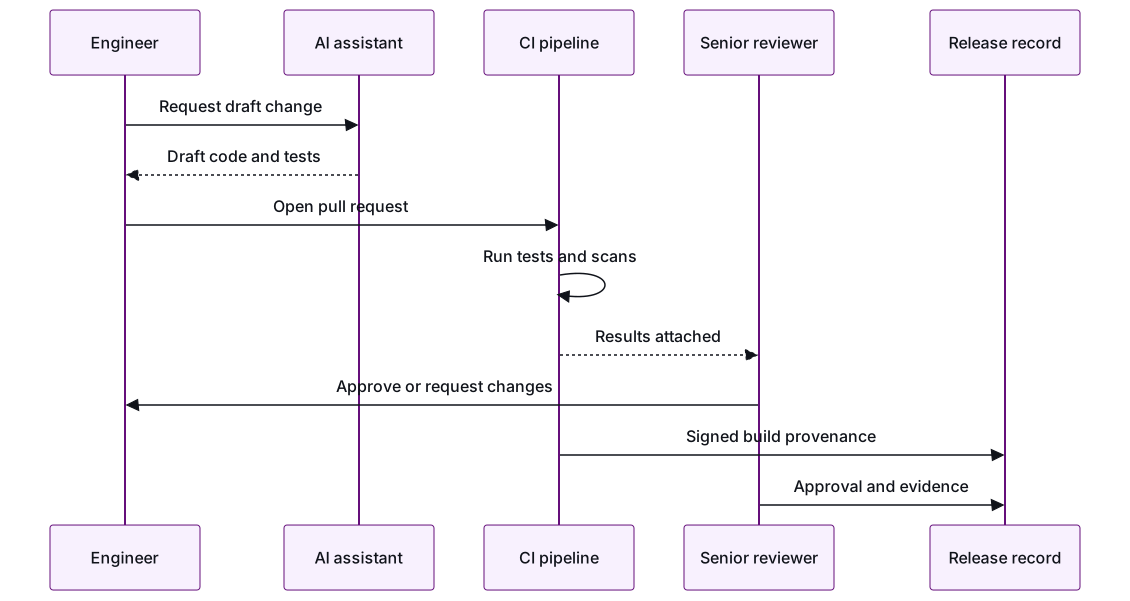
Calidad's Quality Engineering service builds this kind of system: tests, review gates, security checks and release evidence, end to end.
How should a paid pilot confirm everything the sales process claimed?#
A paid pilot should test each claim from the sales process on real work, in your environment, against criteria you both signed beforehand.
Set it up like this:
- One outcome. Choose a real piece of your roadmap that matters, not a toy project.
- Signed success criteria. Agree on what "done" means, the quality bar and the overlap hours before work starts.
- Your repository and your pipeline. The vendor's gates have to work where you can see them.
- The engineers you interviewed. Write the names into the agreement.
- A decision review at the end. Hold one meeting to decide whether to scale, adjust or stop.
At the review, ask two questions. Were the success criteria met? Did the gates, release evidence and working hours hold up the whole time? If both answers are yes, scale. If a gap can be fixed (for example, a missing scan or a slow review loop), adjust and extend. If not, stop, and keep the code, because the contract should say the pilot code is yours.
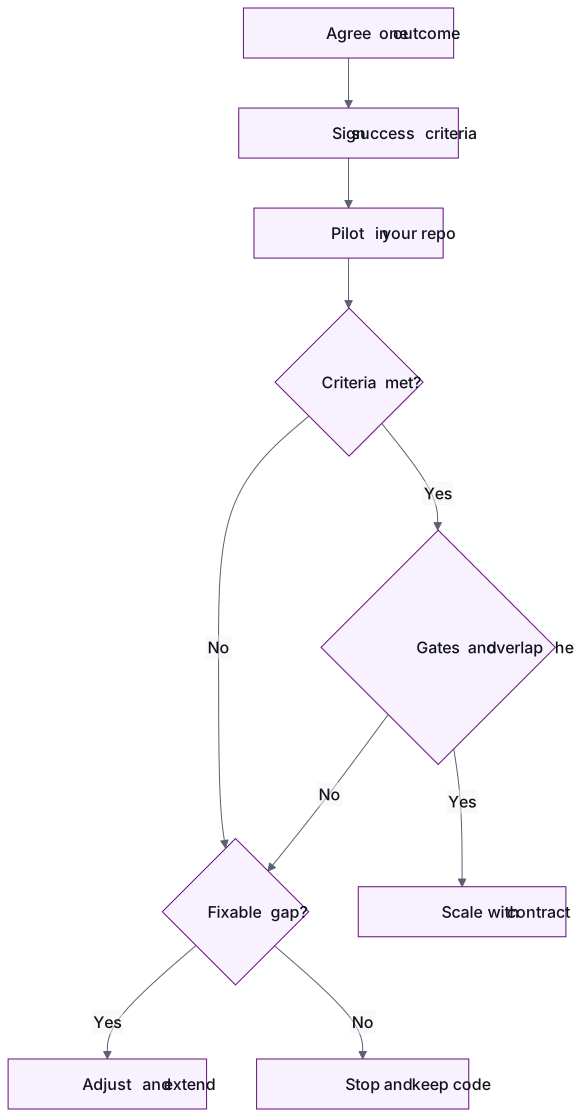
Every Calidad engagement starts this way: a paid pilot with one pod and one outcome, success criteria agreed up front, judged on working software, and no long-term contract. Our post on what a paid software vendor pilot needs has templates for scoping and criteria.
Conclusion#
Choosing an Indian engineering partner well comes down to one habit: ask to see proof. Review real pull requests. Confirm that branch protection and security scans block merges. Pull a past release record. Put named engineers' hours in writing. Find out how AI-written code gets reviewed. Then confirm all of it in a paid pilot before you commit to scale.
If you'd like to see this evidence from us on your own codebase, talk to an engineering lead.
Frequently asked questions
How long should a paid pilot with an Indian engineering vendor last?
Long enough to deliver one real outcome through your full pipeline, including at least a few releases. That's usually a few weeks, not months. If the pilot can't produce a working release, the scope is too big. Agree on the duration and the decision date when you sign the success criteria.
Are ISO or other certifications enough to prove a vendor's quality?
No. Certifications show that a management process exists, but they don't show how a specific team reviews, tests and secures your code. Use them to screen vendors. Rely on repository walkthroughs, enforced pipeline gates, release records and a paid pilot for the real assessment.
Can an Indian team work well with a US-based engineering team?
Yes, but only if engineers shift their working day. A standard 09:00–18:00 IST day has no overlap with US business hours. A 13:00–22:00 IST day gives an East Coast team 2.5 to 3.5 hours of overlap, depending on the season. Write the named engineers' core hours into the contract and check them during the pilot.
Should I let the vendor use AI coding tools on my codebase?
Usually yes, under a written policy. The policy should name the approved tools and their data terms, confirm your code isn't used for model training, and require the same tests, security checks and human review as any other change. Banning AI tools outright is hard to enforce and gives up real speed.
What should happen to the code if a pilot doesn't work out?
You should own it. Make sure the pilot agreement assigns the intellectual property of all pilot work to you and requires handover of the repository, documentation and pipeline configuration. Then stopping costs you only the pilot fee, not the work.
- Outsourcing
- Vendor Selection
- India
- Software Quality
- CTO
Newsletter
Get new articles by email
A short monthly round-up of what we've written on engineering pods, quality and AI. No spam.
