
Time-and-materials (T&M) billing charges you for the hours engineers spend. A fixed-fee pod charges a set price for an agreed outcome, delivered by a whole team. T&M fits work you can't define yet. Fixed-fee pods fit roadmap work where you can name the result, the success criteria and the quality bar before anyone starts.
What is the difference between fixed-fee pods and time-and-materials?#
With T&M you buy effort, and with a fixed-fee pod you buy a result.
Under T&M you pay agreed hourly rates for the time people log, so the final bill depends on how long the work takes. US federal acquisition rules describe a T&M contract as buying services on the basis of direct labor hours at specified fixed hourly rates. A fixed price works the other way. The same rules say a firm-fixed-price contract places upon the contractor "maximum risk and full responsibility for all costs", and it also keeps paperwork for both sides to a minimum.
A fixed-fee pod adds one more change: you're buying from a team, not a list of individuals. A Calidad product engineering pod is a complete team. It has a lead, engineers, QA, DevOps and product, and it owns a slice of the roadmap from the first commit to production.
| Time-and-materials | Fixed-fee pod | |
|---|---|---|
| What you pay for | Hours at agreed rates | An agreed outcome per cycle |
| Who carries overrun risk | You | The vendor |
| Who manages the work | Your managers | The pod's lead, working with your experts |
| Definition of done | Tasks closed, hours logged | Success criteria met and release gates passed |
| How change lands | The bill grows | Traded within the cycle or priced into the next |
| What you review | Timesheets | Working software and release evidence |
Why does billing by the hour misalign vendor and client incentives?#
Hourly billing pays the vendor for effort, so its revenue goes up when work takes longer, whether or not the result gets better.
The vendor doesn't need to act in bad faith for this to happen. The pricing model creates it on its own. Federal acquisition rules say so directly: T&M provides "no positive profit incentive to the contractor for cost control or labor efficiency". That's why those rules require the buyer to supervise the work. In practice:
- Rework is billable. A defect found late costs you twice: once to write the code and again to fix it.
- Ramp-up is billable. The weeks a new engineer spends learning your domain go on your invoice.
- Efficiency cuts the vendor's revenue. Any tool or practice that saves hours also lowers the bill, so the vendor has little reason to adopt it.
- Management stays with you. Someone on your side has to direct the work, check the hours and judge whether progress is real.
Fixed fees have their own risk. A vendor protecting its margin can cut corners on quality. The fix is to write the quality bar into the definition of done, so a shortcut counts as an unfinished outcome rather than a saving. Calidad's comparison with traditional outsourcing sets out this trade. Instead of paying for "hours and headcount", clients pay for agreed outcomes in fixed-fee pods, with tests, security checks and review on every release rather than a testing phase at the end.
How do you define an outcome a pod can be held to?#
An outcome you can hold a pod to is a specific change in working software, with a pass/fail acceptance test, a date and a quality bar, all agreed before work starts.
Vague outcomes lead to disputes. Use these six steps to make one precise:
- Name the result in business terms. "Customers can update billing details in the app without raising a support ticket" is an outcome. "Build the billing settings page" is a task.
- Attach a measure. Pick a number the outcome should move, such as tickets per week, checkout completion or time to onboard, and record today's value as the baseline.
- Write acceptance criteria as tests. Your subject-matter experts know what "correct" means. Write the criteria with them and make as many as possible executable, so whether a criterion passed is a fact and not an opinion.
- Fix the quality bar. Calidad uses three gates on every release: tests prove the change works, security checks prove it's safe and a senior engineer's review proves it's right. Nothing ships without all three, whether a person or an AI wrote the change.
- List what's excluded and what you owe. Fixed fees fail when the client side stalls. Write down the expert time, environment access and decision turnaround the pod depends on.
- Set the cycle and the review point. Short cycles keep each fixed price small enough to estimate honestly.
How are scope changes handled in a fixed-fee pod?#
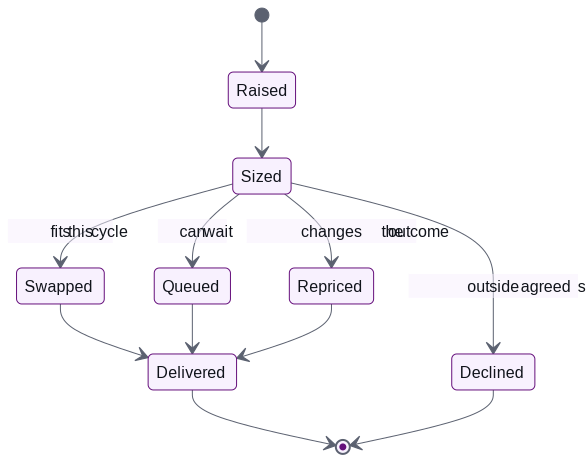
You trade scope changes rather than absorb them. A new request is sized against the current outcome. Then it replaces work of the same size, waits for the next cycle, or changes the outcome and gets a new price.
Most of the friction in fixed-fee work comes from changes that go unspoken. Four rules prevent it:
- Swap, don't stack. If a new request fits the current cycle, something of equal size comes out. The price and the date stay the same.
- Queue by default. Requests that can wait go to the next cycle's outcome, where they're priced with everything else.
- Re-price only when the outcome changes. If the request changes what "done" means, both sides agree a revised outcome and fee before the work starts.
- Separate defects from changes. If delivered work fails the acceptance criteria you agreed, the vendor fixes it within the fee. New behaviour is a change, even if it feels like an obvious extension.
Some requests get declined. These are ones that fall outside the pod's slice of the roadmap or break an exclusion you both agreed. Declining them is still a decision, and you record it so the same request doesn't come back as an argument later.
When is time-and-materials still the better choice?#
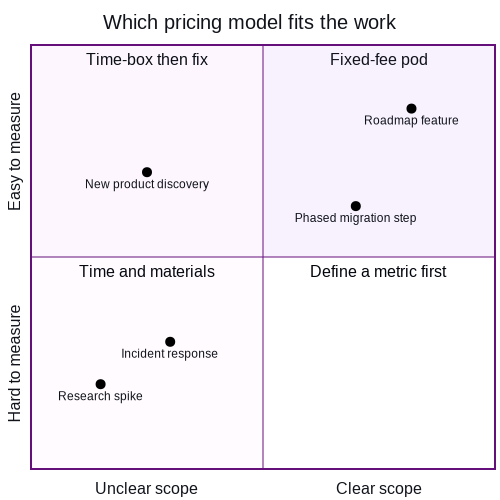
T&M is the better choice when nobody can yet describe the result well enough to price it.
Federal rules take the same view: T&M may be used only when it is not possible to estimate the extent or duration of the work with reasonable confidence. For engineering teams, that usually means:
- Research spikes, where the question is whether something is possible at all.
- Incident response and production support, where the amount of work depends on what breaks.
- Discovery for a new product idea, where the outcome is clear in spirit but you can't yet measure it. Time-box the discovery, then fix the price of the build.
- Short capacity top-ups that your own managers will direct.
Two things often look like T&M work but price well as outcomes. One is roadmap features on a live product. The other is a phased platform migration, where each step has a clear rollback point. If you want engineers who join your team for the long run and take direction from your leads, a dedicated team is a different model from a pod. Those engineers are still measured on what ships.
How does AI-accelerated delivery change how engineering should be priced?#
AI lowers the cost of writing code but not the cost of proving it works, so pricing should follow verified outcomes, not hours.
The evidence on AI speed is mixed:
- In a controlled GitHub Copilot experiment, developers with the AI assistant finished a set programming task 55.8% faster.
- In METR's randomized trial, experienced open-source developers working on real issues in mature repositories took 19% longer when AI tools were allowed. They still believed the tools had made them faster.
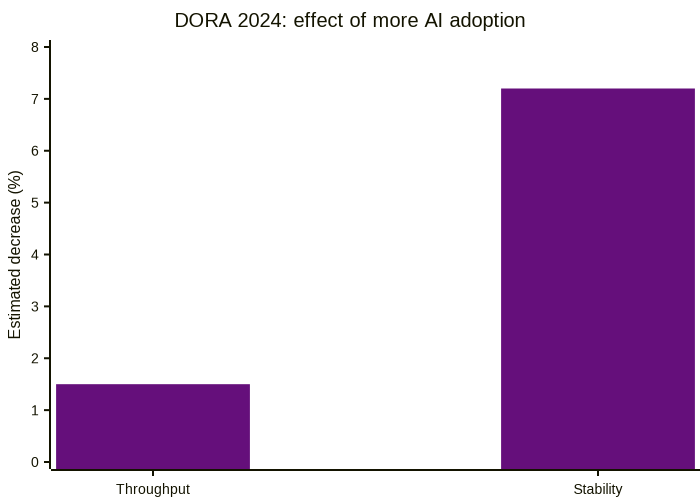
- Google's 2024 DORA research linked higher AI adoption to a 7.2% drop in delivery stability and a 1.5% drop in throughput.
This breaks hourly pricing in two ways. If AI does save hours, a T&M vendor's revenue falls, so it has little reason to pass the savings on. If AI only seems to save hours, as in the METR trial, you pay for the review and rework that follow.
A fixed fee for a verified outcome deals with both problems. Speed gains show up as more outcomes per cycle, and the cost of checking AI-written code sits inside the fee, not on a later invoice. When you compare proposals, ask each vendor whether its price includes tests, security checks and senior review on every change. If the answer is "that's a separate phase", the risk has come back to you.
How do you trial an outcome-based model before signing up?#
Run a paid pilot on one real piece of your roadmap, with success criteria agreed in advance, and judge it on working software.
Calidad starts every engagement this way. The pilot is one pod and one outcome, with success criteria agreed up front. The aim is results in days, and there are no long-term contracts. To get a fair test of any vendor:
- Pick a real outcome, not a showcase. Choose something your team would otherwise build next quarter.
- Write the criteria and the gates first, using the six steps above.
- Embed the pod with your experts. The pod should join the same stand-ups and channels and work toward the same goals, so you see how it really works day to day.
- Inspect the evidence, not just the demo: pull requests, test results, security findings and review records.
- Agree the decision rule before you start: scale, adjust or stop. Add pods only when results build up.
Conclusion#
Paying by the hour makes sense when you're buying exploration. Paying a fixed fee makes sense when you're buying a result you can describe, test and accept. Most organisations need both: T&M or time-boxed work to find the answer, then fixed-fee pods to build it. As AI changes how code gets written, outcome pricing that includes verification is the most direct way to make sure you pay for software that works.
Talk to an engineering lead → https://calidadinfotech.com/contact-us
Frequently asked questions
Is a fixed-fee pod more expensive than time-and-materials?
The rate may look higher per cycle because the vendor carries the overrun risk and has to price it in. What matters is the total cost of an accepted outcome, including rework, your management time and defects found after release. Compare proposals on that basis, not on hourly rates.
Can you mix fixed-fee and T&M in one engagement?
Yes, and that's common. Teams often time-box discovery or support work on hours, then move a defined build to a fixed fee once its outcome and acceptance criteria are clear. The contract should state which work falls under which model.
What happens if a fixed-fee pod misses the agreed outcome?
That depends on the contract. The usual principle is that work failing the agreed acceptance criteria gets fixed within the fee. Short cycles limit the exposure on both sides, and a pilot with a pre-agreed decision rule lets you stop before committing further.
How long should a fixed-fee cycle be?
Short enough that both sides can estimate it honestly and review real software at the end. Longer cycles mean bigger estimates and more room for disagreement about scope. If you can't define an outcome for the cycle, the work probably isn't ready for a fixed fee.
Do fixed-fee pods work for GCCs and long-term teams?
They can. A pod can own a stable slice of the roadmap for a long time, with a new outcome agreed each cycle. For teams you want to direct yourself over the long run, a dedicated team or a GCC built pod by pod may fit better.
- software development
- pricing
- engineering pods
- outsourcing
Newsletter
Get new articles by email
A short monthly round-up of what we've written on engineering pods, quality and AI. No spam.
