
How to hire a dedicated software development team in India: write down the outcome and roles first. Then choose a vendor that lets you interview every engineer, gives you one delivery lead and runs tests, security checks and review on every change. Agree on 2–4 hours of shared working time each day, start with a paid pilot and grow only when the results hold.
When does a dedicated team in India make sense for a product company?#
A dedicated team makes sense when you have roadmap work that will run for a long time, you can't hire enough engineers locally, and you want people who stay long enough to learn your system.
India has a large pool of engineers to hire from. According to India Briefing, the tech sector added about 126,000 net new jobs in FY2024–25, taking the total workforce to 5.8 million. Many of your peers already run engineering there. The Zinnov–nasscom GCC report counts more than 1,760 Global Capability Centers in India.
Signs that a dedicated team fits:
- Your backlog grows faster than you can hire, and the work won't end next quarter.
- You have a product or engineering lead who can set priorities for the extra engineers every day.
- Contractors keep rotating out, and the knowledge of your system leaves with them.
It's the wrong model for a fixed-scope project with an end date. A project contract fits that better. If you need more engineers but nobody on your side has time to direct them, hire a team that owns an outcome instead, such as a product engineering pod.
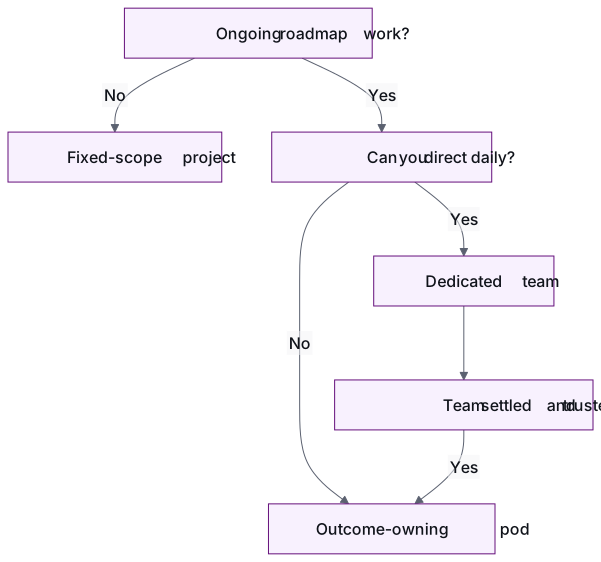
The two models connect. A dedicated team that has settled in can later take full ownership of a product area.
How do you define the roles and outcomes before you hire?#
Start with what the team should achieve in its first 90 days. Then work back to the skills that outcome needs. Don't start from job titles.
- Write one outcome. Make it specific and checkable, for example: "Move the billing service onto the new API with no customer-facing incidents."
- List skills, not titles. "Senior backend engineer" doesn't tell anyone much. "Go, Postgres, has run event-driven payment flows in production" does.
- Set the seniority mix. A first team needs at least one senior engineer who can make design calls without waiting a day for an answer.
- Define "done". Code merged isn't enough. Done should mean tested, reviewed, deployed and monitored.
- Name a manager on your side. Every engineer needs someone in your organisation who sets priorities and approves designs.
- Design the interview loop. Use your own technical interview, not just the vendor's CVs. Include a code review exercise, because reviewing AI-written code is now a large part of the job.
How should you assess a vendor's code quality, security and review practices?#
Ask the vendor to show you its quality gates working on real changes, and check that they run on every change, whether a person or an AI tool wrote it.
This matters more now than it did three years ago. In the 2025 Stack Overflow Developer Survey, more developers distrusted the accuracy of AI tools (46%) than trusted it (33%). Your vendor's engineers almost certainly use AI tools. What matters is how their output gets verified before it ships.
| Question to ask | Good answer | Red flag |
|---|---|---|
| What runs on every pull request? | Automated tests, security and dependency scans, all required to pass | "QA tests it before release" |
| Who reviews AI-written code? | A named senior engineer, every time | "The AI reviewer handles it" |
| What are the rules for AI tool use? | Written guidelines agreed with you up front | Each engineer decides |
| Can we interview every engineer? | Yes, and you approve each one | Pre-selected profiles only |
| Who is accountable when delivery slips? | One delivery lead | An account manager who doesn't know your code |
| How do engineers access data? | Least-privilege access, no production personal data on laptops | Shared credentials |
Data handling deserves a direct question. India's Digital Personal Data Protection Act, 2023 has been fully in force since the DPDP Rules were notified on 14 November 2025. That sits alongside your own obligations, such as GDPR.
At Calidad, nothing ships without three gates: tests show it works, security checks show it's safe, and a senior engineer's review shows it's right. Our guide to verifying AI-generated code before production covers each gate in detail.
How much time-zone overlap do you really need?#
Most teams need 2–4 hours of shared working time a day. That covers decisions, code review and unblocking. Everything else can happen asynchronously.
India Standard Time is UTC+05:30 and does not observe daylight saving time. The gap to you therefore shifts by an hour whenever your own clocks change. In November, IST is 10.5 hours ahead of New York, 5.5 hours ahead of London, 4.5 hours ahead of Berlin, 3.5 hours ahead of Johannesburg and 2.5 hours behind Singapore.
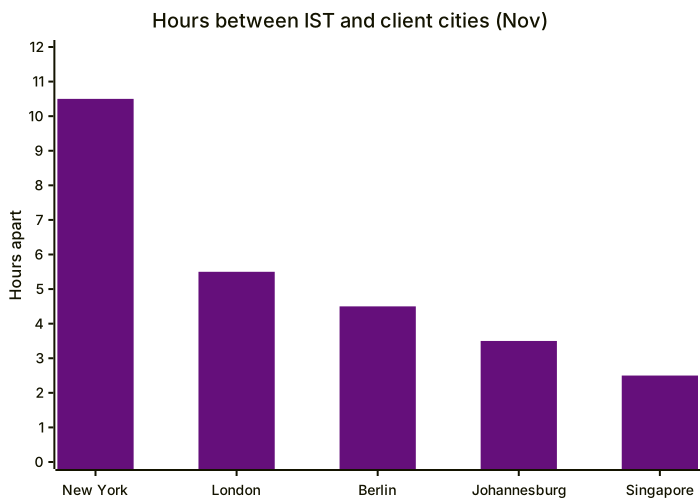
Here's what that means in practice:
- UK and Europe: A normal Indian working day already overlaps your morning by about three hours. You don't need shifted schedules.
- US East Coast: A 9-to-6 IST day doesn't overlap at all. To get about three shared hours, the Indian team has to work a later shift, roughly 1:30 pm to 10:30 pm IST.
- Singapore: You share most of the working day.
Put the meetings that need decisions inside the overlap: stand-up, design review and sprint planning. Handle updates, small code reviews and questions in writing, and set a response-time norm so nobody waits a full day for an answer. Our Dedicated Teams engineers, based in Ahmedabad and Bengaluru, work in the client's time zone.
What drives the monthly cost of a dedicated engineering team?#
Monthly cost depends mostly on the seniority mix, how scarce the skills are, the hours you ask the team to work, and what the vendor includes in the price. Team size alone tells you little.
Things that raise or lower the bill:
- Seniority mix. A team led by seniors costs more per head but needs less of your own senior engineers' time.
- Skill scarcity. Common web stacks are easier to staff than niche platforms, ML infrastructure or regulated domains.
- Working hours. Later shifts for US overlap narrow the pool of candidates and can change the price.
- What's included. Check whether the delivery lead, QA automation, DevOps support and AI tool licences are in the rate or billed separately.
- Pricing model. You either pay for hours and headcount, or pay a fixed fee for an agreed outcome.
- Flexibility terms. Find out how much notice you need to give to add or release engineers.
There are also costs that never appear on an invoice: ramp-up time, the context you lose when people rotate out, and the hours your senior staff spend fixing poorly reviewed code. A cheaper rate that doubles your review burden isn't cheaper. Ask each vendor to break its quote down the same way so you can compare them line by line.
How do you onboard dedicated engineers into your rituals and tools?#
From day one, treat dedicated engineers like new employees. They get the same channels, stand-ups, repository access and definition of done as everyone else, plus one person who owns their onboarding.
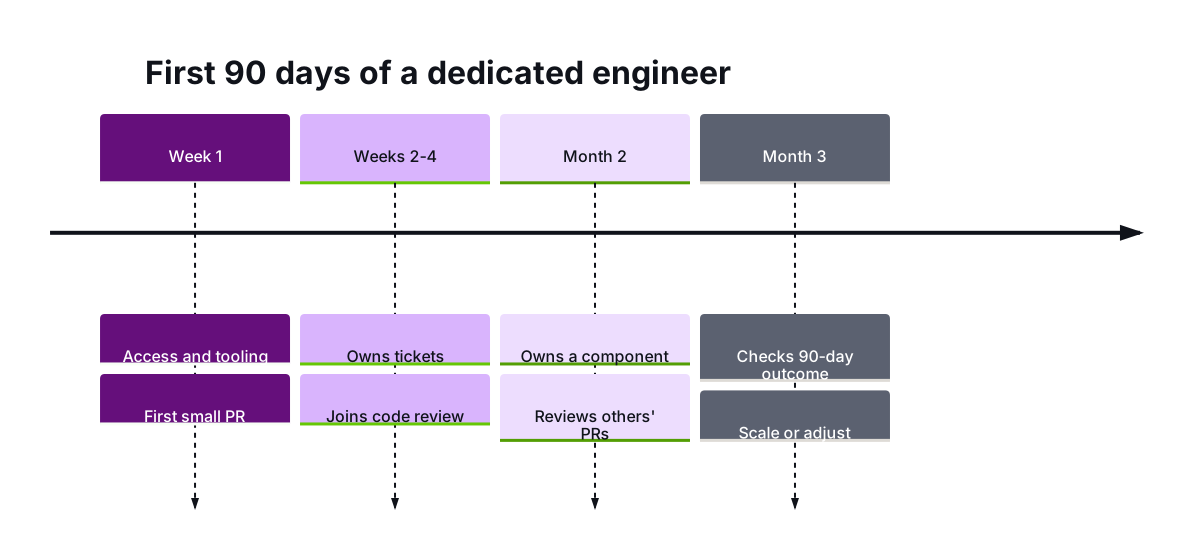
- Before day one: set up accounts, repository and CI access, a local development guide and a first ticket that's already scoped.
- Week one: walk them through the architecture, pair each engineer with someone on your team, and have them ship one small change through the full pipeline.
- Weeks two to four: they pick up normal tickets and take part in code review in both directions.
- Months two and three: each engineer owns a component, and you check progress against the 90-day outcome you wrote before hiring.
In our Dedicated Teams practice, a delivery lead owns onboarding, tracks progress and is your single point of accountability. The rules for code review, tests and AI tool use are checked every sprint.
How do you measure whether the team is working, and when should you scale?#
Judge the team on whether it delivers the outcome you wrote down, at stable delivery and quality levels. Hours logged and tickets closed don't tell you that.
Track a small set of signals from the first sprint:
- Delivery: the four DORA metrics, which are deployment frequency, lead time for changes, change failure rate and time to restore.
- Quality: defects that reach users, and how much merged work has to be redone.
- Review load: how long reviews take, and how much of your senior engineers' time the team consumes.
- Continuity: whether the same engineers are still there, and whether problems get raised early or only at the deadline.
Grow the team when the 90-day outcome is met, the metrics have held steady or improved for several sprints, and the team can onboard a new member without your help. Then you have two options: add engineers, or turn the settled team into a pod that owns a product area end to end. If the signals stay flat, change the scope or the people before you add headcount. A paid pilot with agreed success criteria is the cheapest way to get those signals before you sign a longer agreement.
Conclusion#
Hiring a dedicated team in India works when you treat it as building part of your own team, not buying hours. In short:
- Define the outcome and the skills you need.
- Interview every engineer yourself.
- Insist on tests, security checks and senior review for every change.
- Agree on a few hours of overlap that suit your time zone.
- Measure the team against the outcome before you grow it.
Start small, keep the standards strict and add people only when the results justify it.
Ready to scope your first team? Talk to an engineering lead →
Frequently asked questions
What's the difference between a dedicated team and a product engineering pod?
With a dedicated team, engineers join your team and work on priorities you set every day. Your managers direct the work. A pod is a complete product team with a lead, engineers, QA, DevOps and product skills. It owns a slice of your roadmap from first commit to production. Many companies start with dedicated engineers and turn a settled team into a pod later.
Do I get to interview the engineers myself?
You should, and you shouldn't settle for a vendor that says no. In Calidad's Dedicated Teams practice, engineers are matched to your stack, domain and working style, and you interview and approve every one before they join.
How small can a first dedicated team be?
Small enough to prove the model. Calidad clients can start with two engineers and grow into a team that owns its own roadmap. Engagements begin with a paid pilot, and there are no long-term contracts.
How do we handle code ownership and confidentiality?
Put intellectual property assignment, confidentiality and data-access rules in the master services agreement and statement of work before any work starts. Don't share confidential material until an NDA or services agreement is signed. If engineers will touch personal data, write least-privilege access rules into the agreement as well.
What if the team works well on delivery but our review burden keeps growing?
That's a warning sign. It usually means AI-assisted output isn't being checked well enough before it reaches your reviewers. Agree on shared rules for AI tool use, required tests and senior review on the vendor's side, and track review load as a metric alongside delivery speed.
- dedicated teams
- hiring
- India
- software development
- outsourcing
- product engineering
Newsletter
Get new articles by email
A short monthly round-up of what we've written on engineering pods, quality and AI. No spam.
