
A product engineering pod is a complete team (a lead, engineers, QA, DevOps and product) that owns one outcome on your roadmap and answers for what ships. Staff augmentation adds individual engineers who work under your management. Choose a pod when you want part of the roadmap delivered and owned for you. Choose augmentation when you have spare management capacity and just need more people.
Most scale-up CTOs who ask this are short of delivery capacity, short of management time, or both. The three common models (pods, staff augmentation and dedicated developers) solve different problems. This post compares them on ownership, accountability, ramp-up and control so you can match the model to the work.
What is a product engineering pod?#
A product engineering pod is a small team with every role needed to take one part of your product from first commit to production, and it is accountable for that result.
The idea is close to what Team Topologies calls a stream-aligned team, which is aligned to a flow of work from one part of the business domain. IT Revolution's summary says such a team can be aligned to a single product, a set of features, or a user journey. A pod applies that structure to an external partner.
At Calidad, a Product Engineering Pod has five roles:
- Engineering lead: owns technical direction and delivery
- Full-stack engineers: build the features
- QA and automation: tests every change
- DevOps: owns pipelines and releases
- Product and UX: turns the outcome into work items
Pods are priced on agreed outcomes in fixed-fee pods, not on hours and headcount. They work inside your team: the same stand-ups, the same channels and the same goals as your subject-matter experts. Every change passes three gates before release: tests, security checks and a senior engineer's review. This applies whether a person or an AI wrote the code.
What does staff augmentation actually give you?#
Staff augmentation gives you extra engineers, billed for their time, who take direction from your managers and follow your processes.
You get capacity and a fast way to fill a known skill gap. You keep everything else:
- Direction: your managers write tickets, set priorities and run the sprints.
- Quality: your reviewers approve pull requests and your pipeline decides what ships.
- Delivery risk: if the feature is late or broken, that is your team's problem.
- People management: onboarding, performance and replacement requests all go through you.
There is also a legal side to check. In the UK, if you engage contractors through their own limited company or another intermediary, HMRC's off-payroll working rules (IR35) may apply. HMRC publishes a flowchart for client organisations to help you work out whether you are affected. Ask your legal team before you sign.
How do dedicated developers differ from a pod?#
Dedicated developers are long-term engineers who join your team and work on your priorities. A pod is a complete unit that owns an outcome on its own.
Dedicated developers are somewhere between augmentation and a pod. Calidad's Dedicated Teams are engineers from India who join your product for the long run and work in your time zone. They are chosen for fit and supported by a delivery lead, and they are held to standards you can check. The difference from augmentation is that a vendor-side lead is responsible for standards, and the engineers are measured on what they ship, not on hours logged.
The difference from a pod is structural:
- Who decides the work: with dedicated developers, your product managers and tech leads still assign it. A pod turns an agreed outcome into its own backlog.
- Who covers the roles: a dedicated team fills the roles you are short of. A pod has every role it needs already.
- What you buy: dedicated developers add capacity inside your structure. A pod takes on a slice of your roadmap.
Who is accountable for the outcome in each model?#
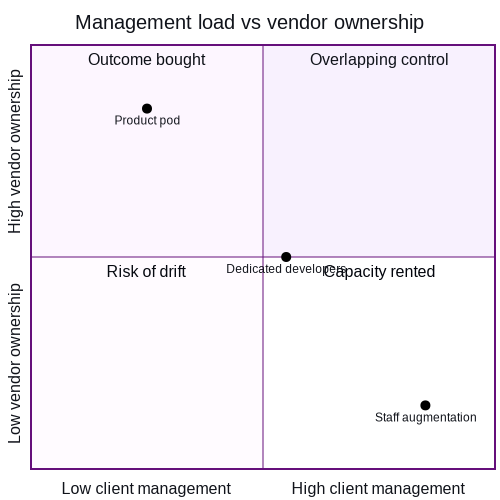
In a pod, the vendor is accountable for the outcome. In staff augmentation, you are. With dedicated developers, you own the outcome and the vendor shares responsibility for standards and delivery.
| Staff augmentation | Dedicated developers | Product engineering pod | |
|---|---|---|---|
| What you pay for | Time | Long-term people | An agreed outcome |
| Who sets the work | Your managers | Your managers | The pod, against your outcome |
| Who owns quality | You | Shared: your process, vendor lead's standards | The pod, through its release gates |
| Who absorbs delivery risk | You | Mostly you | The pod |
| Your management load | High | Medium | Low: you set outcomes and review results |
| Your control over how the work is done | Full | High | Lower; you control what, not how |
The tradeoff is direct: the more ownership you hand over, the less day-to-day control you keep. A pod suits you if you care about what ships more than how the tickets are split. If your architecture is fragile or under strict internal rules, you may want to keep more control.
How do ramp-up time and knowledge retention compare?#
A pod gets up to speed as one unit around one outcome, so it usually needs less of your time. Augmented engineers each get up to speed separately, using your team's time. How much knowledge you keep depends mainly on how long people stay and whether what they learn is written down.
Fred Brooks described the ramp-up cost in 1975: "adding manpower to a late software project makes it later". New people need training and need to coordinate with the team, and your existing engineers provide both. With augmentation, every new person adds to that load. In a pod, the lead absorbs most of the context and passes it to the rest of the pod. Your experts explain the domain to one team, not to five individuals.
To keep knowledge, check where it lives:
- In people: long-term engineers keep context and short contracts lose it. Ask how often the vendor rotates people off accounts.
- In the repository: architecture decisions, runbooks and test suites should be committed alongside the code, not left in someone's head.
- In the pipeline: release gates written as code still work after the person who wrote them leaves.
Whichever model you choose, require the second and third.
Which model fits a scale-up with a live roadmap?#
For a live roadmap with changing priorities and a small management layer, a pod or a dedicated team usually fits better than staff augmentation.
At a scale-up, management time is usually scarcer than engineering time. DORA's 2024 research found that unstable organisational priorities cause meaningful drops in productivity. Each augmented engineer is one more person who has to be told when priorities change. A pod working toward an outcome absorbs the change inside its own backlog.
Three questions decide it:
- Is the work bounded and short? Examples are a migration spike or covering for parental leave. If so, and you have spare managers, augmentation works.
- Is the work ongoing? If you want an external team to own the result, use a pod.
- Do you want to keep design and priorities in-house but need lasting capacity? Use dedicated developers.
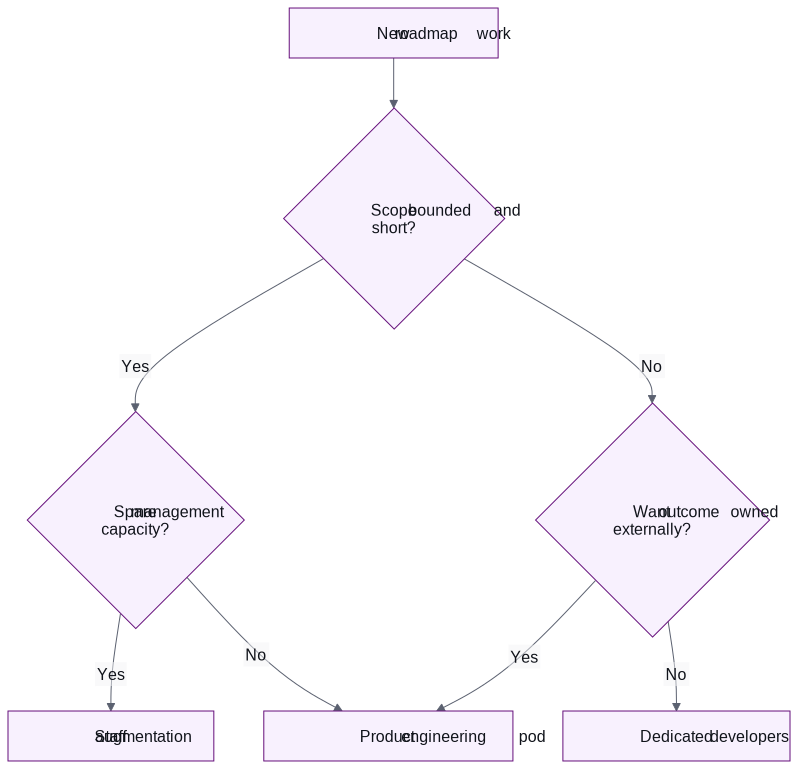
A short task with no one free to manage it still goes to a pod. Augmented engineers without a manager tend to drift.
When is staff augmentation still the right choice?#
Staff augmentation is still the right choice when the gap is a narrow skill or a short period, and your own managers have time to direct the work.
It fits these cases:
- A specific skill for a set period: for example, someone who knows a payment provider's API well during an integration.
- Temporary cover: leave, a hiring freeze or a gap before a full-time hire starts.
- Strong in-house management with spare time: your tech leads can absorb more people without becoming the bottleneck.
- Work that must stay under your direct control: for example, because of internal policy or how your audit trail is set up.
Even then, apply the same release standard to augmented engineers as to your own staff, especially now that much of the code is written with AI help. Our guide to verifying AI-generated code before production explains how to enforce tests, security checks and senior review in the pipeline, whoever wrote the change.
How do you test the model with a paid pilot?#
Run one team on one real outcome for a fixed period, with success criteria agreed before you start, then decide whether to scale, adjust or stop.
The setup:
- Pick one outcome that matters. Choose a feature, a module or a reliability target. Avoid a sandbox exercise.
- Write the success criteria first. Say what "done" means, which gates every change must pass and what evidence you will review.
- Embed the team with your experts. Use the same stand-ups and channels, so you are judging how the team works with your people, not a demo.
- Review working software. At the end, look at merged code, test results and release evidence, not slides.
- Decide. Scale if the criteria were met, adjust the scope if they were partly met, and stop if they were missed.
This is how Calidad starts every engagement: a paid pilot with one pod and one outcome, success criteria agreed up front, judged on working software. There are no long-term contracts, so if the model doesn't fit, you stop.
So which should you choose?#
- Staff augmentation: use it when you have managers with spare time and a bounded gap.
- Dedicated developers: use them when you want lasting capacity and want to keep direction in-house.
- A product engineering pod: use it when you want a slice of the roadmap delivered and owned for you, with tests, security checks and review on every release.
Whichever you lean toward, test it on real work before you commit.
Want to test a pod on one outcome from your roadmap? Talk to an engineering lead →
Frequently asked questions
Is a product engineering pod more expensive than staff augmentation?
The two are priced differently, so day rates don't compare directly. Augmentation bills for time, and you separately pay for the management, review and delivery risk your own team takes on. A pod is priced on an agreed outcome, so compare the total cost of getting that outcome shipped under each model.
Can I combine a pod with augmented or dedicated engineers?
Yes. Many teams use a pod for one well-defined slice of the roadmap and dedicated or augmented engineers to add capacity elsewhere. Make it clear which team owns which outcome, and run every change through the same release gates.
How long should a paid pilot run?
Long enough to ship real, reviewable work against the criteria you agreed, and no longer. Set the window when you write the success criteria, and fix the decision review date before the pilot starts.
What happens to knowledge if we end a pod engagement?
It should stay in your repository and pipeline: committed tests, architecture decision records, runbooks and release gates written as code. Make these a written requirement from the start so a handover doesn't depend on any one person.
- product engineering
- staff augmentation
- dedicated developers
- engineering teams
- outsourcing
Newsletter
Get new articles by email
A short monthly round-up of what we've written on engineering pods, quality and AI. No spam.
