
A quality engineering pod is a small cross-functional team that builds a slice of your product and owns the proof that it works. Every change passes automated tests, security checks and senior engineer review before release, whether a person or an AI wrote it. The pod keeps the evidence. Quality is built in from the start, not checked at the end.
That is the short answer. The rest of this post explains what the pod is responsible for, how a change gets to production, and how this model compares with staff augmentation or a separate QA team. Those are the two arrangements most engineering leaders are weighing it against.
Why does AI-written code need a pod that owns quality?#
Coding assistants produce more changes than review and testing were built to handle, so someone has to own verification for every change.
Use is nearly universal, but trust is low. In the Stack Overflow 2025 Developer Survey, 46% of developers said they distrust the accuracy of AI tools and 33% said they trust it. Only 3% said they highly trust the output. Experienced developers were the most cautious group.
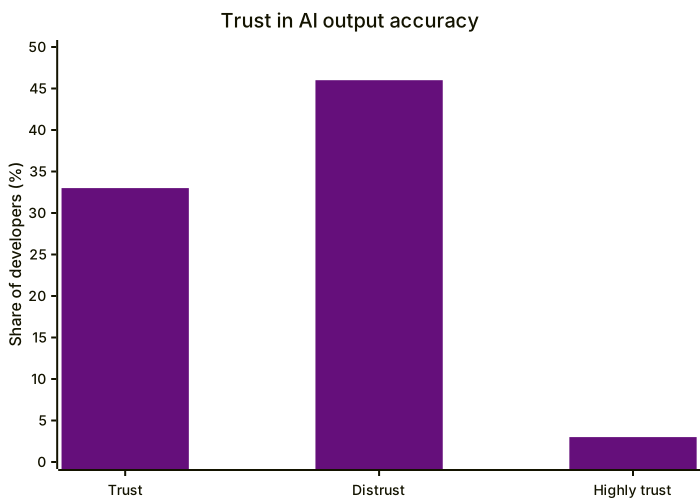
The skepticism shows up in the delivery data and in security tests:
- Stability. Google Cloud's 2025 DORA report found that AI adoption still has a negative relationship with software delivery stability. It also found that without strong automated testing, mature version control and fast feedback loops, more changes lead to more instability.
- Security. Veracode's 2025 GenAI Code Security Report found that AI-generated code introduced risky security flaws in 45% of its tests. The report covered more than 100 large language models.
The takeaway is that AI makes writing code cheap but doesn't make it trustworthy. A pod puts the checks inside the team that writes the code, so verification grows as the number of changes grows.
What does a quality engineering pod own?#
The pod owns a business outcome and the evidence that each release delivers it safely. It doesn't just own a list of test cases.
In practice that covers five things:
- A slice of the roadmap. This could be a product area, a user journey or a set of services, from first commit to production. This is close to what Team Topologies calls a stream-aligned team: one that delivers its stream of work from beginning to end without handing parts of it to other teams.
- The tests. Unit, integration and end-to-end tests are written alongside the code. AI can draft tests, but an engineer reviews them before they count.
- The security checks. Dependency, secret and code scanning run on every change, and the pod fixes or escalates what they find.
- The review gate. A senior engineer approves every change before it merges, and AI-written changes get no exception.
- Release evidence. Each release has a record of what changed, which tests and scans ran, what they found and who approved it. An auditor, a security lead or your CTO can follow that record without a meeting.
At Calidad, this is how every Product Engineering Pod runs. Each pod has a lead, engineers, QA, DevOps and product. Our standard is three gates: tests prove the change works, security checks prove it's safe, and a senior engineer's review proves it's right. Nothing ships without all three. For teams that already have engineers and need the verification system itself, our Quality Engineering service builds the same gates and release evidence into their pipeline.
How does the pod work with your in-house experts?#
The pod joins your team's routines: the same stand-ups, the same channels, the same goals. Your experts define what "correct" means, and the pod proves each change meets that definition.
This matters more with AI than without it. An assistant can produce code that compiles and passes its own tests but misreads a business rule. Only people who know the domain catch that kind of error. When engineers sit with your experts from day one, acceptance rules come from the people who own the business, not from a ticket written two hand-offs away.
The diagram below shows how one change typically moves between your experts, the pod and its tools.
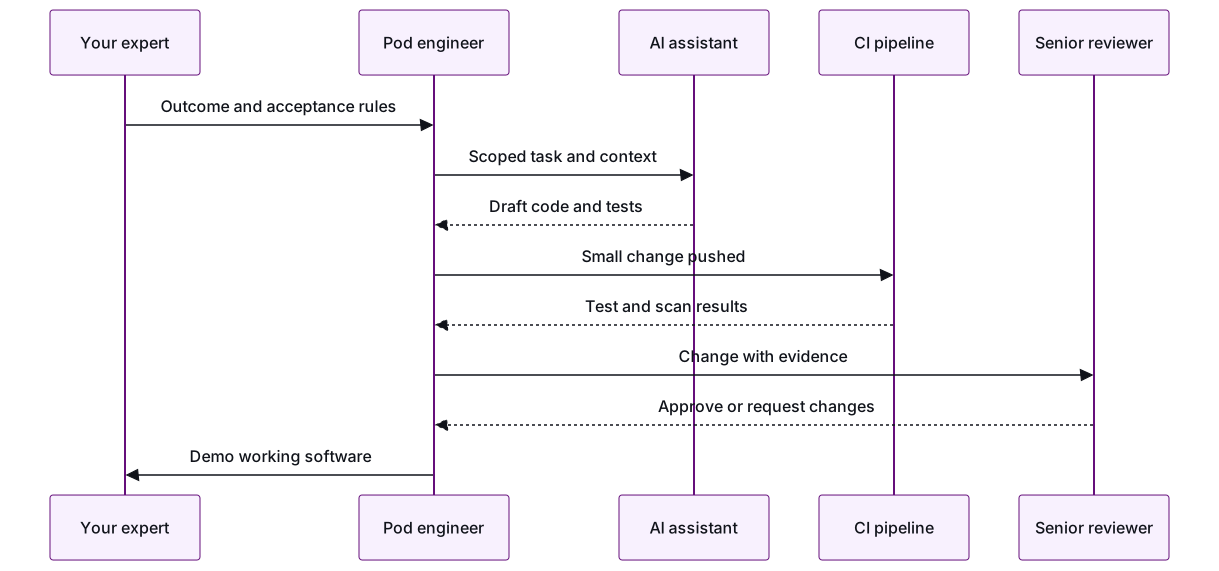
Two habits keep this loop fast:
- Small changes. A reviewer can check a 50-line change properly. A 2,000-line AI-generated pull request usually gets a skim.
- Acceptance rules up front. The expert states what correct looks like before work starts, so tests encode business intent rather than whatever the code happens to do.
How does a change get from AI draft to release?#
A change moves through three gates in a fixed order, and failing any gate sends it back to draft instead of on to a later phase.
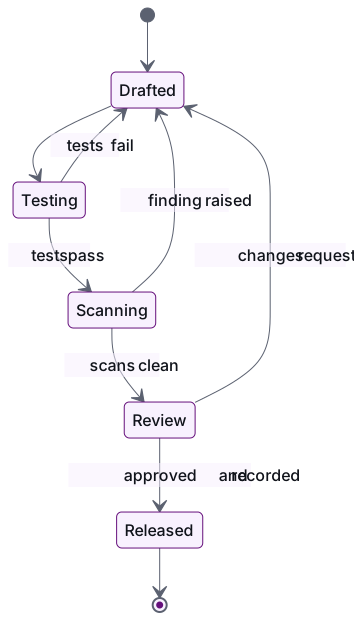
The order is deliberate:
- Tests run first because they're cheap and fast. A reviewer shouldn't spend time on code that doesn't work.
- Security scans run second so known problems, such as a hard-coded secret, a vulnerable dependency or an injection pattern, are flagged before anyone reviews the change.
- Senior review runs last, when the change is known to work and to be free of known issues. The reviewer can focus on what tools miss: whether the logic matches the business rule, whether the authorization is right, and whether the design will hold up.
The release record is written as the change moves through the gates, not put together after release. That's what turns "we test everything" into something you can check. For a deeper look at the gates themselves, see our guide on verifying AI-generated code before production.
How is a pod different from staff augmentation or a separate QA team?#
The difference is who owns the outcome. Staff augmentation sells capacity you manage, and a separate QA team checks work after someone else builds it. A pod builds the software and is accountable for whether it works.
| Staff augmentation | Separate QA team | Quality engineering pod | |
|---|---|---|---|
| What you pay for | Hours and headcount | Testing capacity | An agreed outcome |
| Who manages the work | Your managers | Your managers or the QA lead | The pod's lead, with your experts |
| When quality is checked | Depends on your process | In a testing phase after development | On every change, before merge |
| Who reviews AI-written code | Your senior engineers | Usually no one; QA tests behavior, not code | A senior engineer inside the pod |
| Release evidence | Whatever your pipeline records | Test reports, separate from code history | Tests, scans and approvals per release |
| Common failure | Review piles up on your seniors | Defects found late, then thrown back | Needs a clearly defined roadmap slice |
Staff augmentation works when you have strong engineering management and spare review capacity. Its weakness with AI is that your senior engineers end up reviewing everyone's AI-assisted output, so review becomes the bottleneck.
A separate QA team finds problems after they're built, which is the most expensive time to find them. It also can't review code structure or security, because it tests behavior. If your auditors or regulators expect independent sign-off, keep that function. Have it review the pod's evidence rather than re-run the pod's checks by hand.
A pod removes the hand-off. The same people who write the code, with AI's help, also prove it's correct. That works best when the pod has a clear area to own.
If you mainly need more capacity, a middle option is a long-term Dedicated Team. Its engineers work under a delivery lead with shared rules for code review, tests and AI tool use. Once the team is settled, it can become a pod that owns an outcome.
Which model fits your situation?#
Choose based on whether you need an outcome delivered or more hands, and on whether you can absorb the review load yourself.
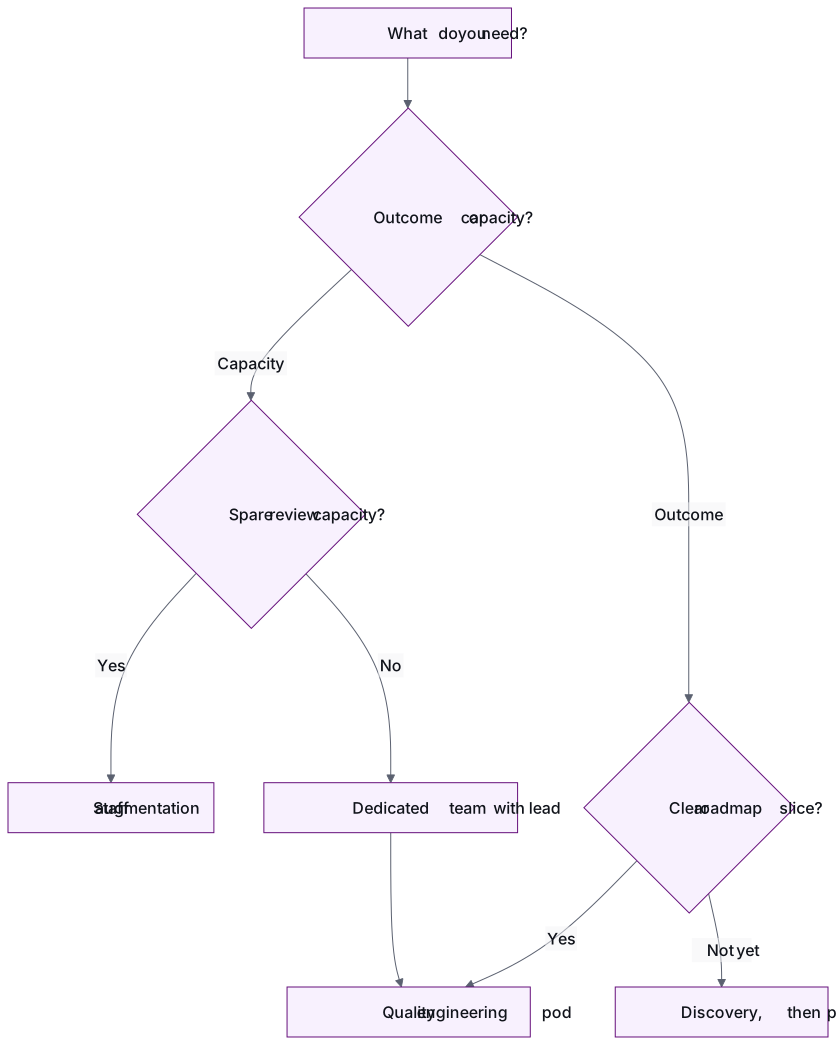
A few signs that a pod fits:
- Your seniors spend more time reviewing AI-assisted pull requests than designing systems.
- Defects regularly come back from a late testing phase or from production.
- You can't easily show an auditor or customer what was checked before a release.
- You have a product area that a team could own end to end.
How do you start with a quality engineering pod?#
Start with a paid pilot: one pod, one outcome, with success criteria agreed before work begins.
A good pilot defines:
- One outcome, such as a feature, a migration step or a stabilized service, that matters to the business.
- Success criteria, for example the release gates in place, the evidence produced and the agreed scope shipped.
- The experts involved: who on your side defines correct and joins the stand-ups.
- The decision rule: what result means scale up, adjust or stop.
You judge working software, not a pitch. Our guide to what a paid software vendor pilot needs goes through scoping and success criteria in detail.
Conclusion#
AI has made code cheap. Verifying that code is now the slow part. A quality engineering pod keeps verification inside the team that writes the code: tests, security checks and senior review on every change, with release evidence anyone can check. Unlike staff augmentation or a separate QA team, it's accountable for the outcome as well as the effort.
If you have a part of your roadmap where AI-assisted speed is starting to hurt stability, start there. Talk to an engineering lead →
Frequently asked questions
How big is a quality engineering pod?
A pod is a small, complete product team: an engineering lead, engineers, QA and automation, DevOps, and product and UX. The exact size depends on the roadmap slice it owns. Start with one pod on one outcome and add pods as results build up.
Does a quality engineering pod replace our in-house QA team?
Not necessarily. The pod owns verification for the work it ships, so your QA team no longer has to catch its defects late. If you need independent sign-off for audit or regulatory reasons, that team can review the pod's release evidence instead of re-running its tests by hand.
Who reviews AI-generated code in a pod?
A senior engineer inside the pod reviews every change before it merges, whether a person or an AI wrote it. Review comes after automated tests and security scans have passed, so the reviewer can focus on business logic, authorization and design, which tools tend to miss.
What is release evidence?
Release evidence is a record, kept for each release, of what changed, which tests and security scans ran, what they found and who approved the change. It's built up as the change passes each gate. That lets security leads, auditors or executives check what was verified without depending on anyone's memory.
Can a staff augmentation team become a pod?
Yes. A long-term team that works under a delivery lead with shared standards for review, tests and AI tool use can take on ownership of a product area once it knows your system well. The change is mostly about accountability: the team moves from completing tickets to owning an outcome and its evidence.
- quality engineering
- AI-generated code
- code review
- software delivery
- engineering teams
Newsletter
Get new articles by email
A short monthly round-up of what we've written on engineering pods, quality and AI. No spam.
