
A software quality engineering company, when AI writes much of the code, owns the system that proves each change is safe to ship: automated tests, security and dependency checks, a senior engineer's review, and a release record that shows all three happened. It works inside your delivery team, on every change, not as a testing phase at the end.
That definition matters more each quarter. Code is now cheap to produce. Knowing that it works, that it's safe and that it does what the business needs still takes engineers. This post covers what that work involves, how it differs from hiring a separate testing vendor, and how to choose a partner.
Why does AI-written code need its own quality system?#
AI writes code faster than people can read it carefully, and code that compiles and passes a demo is often not secure or correct.
The research is consistent:
- Security flaws are common. Veracode's 2025 GenAI Code Security Report tested 80 coding tasks across more than 100 large language models. The code usually worked, but it introduced security vulnerabilities in 45% of cases. The models also missed 86% of cross-site scripting threats.
- Some dependencies don't exist. A USENIX Security 2025 study analysed 576,000 generated code samples. It found that 19.7% of recommended packages were hallucinations, covering 205,474 unique package names that don't exist on PyPI or npm. The average rate was at least 5.2% for commercial models and 21.7% for open-source models. An attacker can register one of those names and wait for someone to install it.
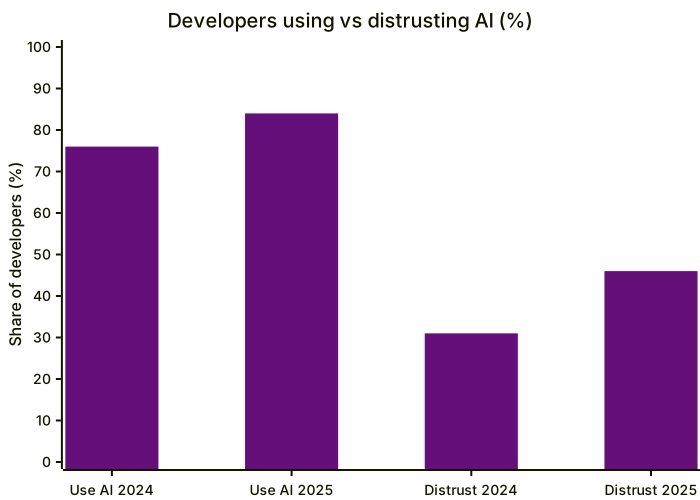
- Developers are wary. In the Stack Overflow 2025 Developer Survey, 84% of developers said they use or plan to use AI tools, up from 76% in 2024. But 46% said they don't trust the accuracy of AI output, up from 31% the year before.
Google's 2025 DORA report surveyed nearly 5,000 technology professionals. Its main finding is that AI doesn't fix a team. It amplifies what's already there, good or bad. A team with weak review and thin tests will simply ship weak code faster. The quality system is what decides which kind of team you become.
What does quality engineering own in an AI-assisted team?#
It owns four controls, built into the pipeline and enforced on every change, whether a person or an AI agent wrote it.
| Control | What it proves | What it catches in AI-written code | Evidence it leaves |
|---|---|---|---|
| Tests | The change does what the acceptance criteria say | Edge cases the model never considered; regressions in nearby code | Test run results tied to the commit |
| Security and dependency checks | The change doesn't open a known hole | Injection patterns, hard-coded secrets, packages that don't exist or aren't approved | Scan reports and an approved dependency list |
| Review gate | A senior engineer agrees it is right | Wrong business logic, missing authorization checks, designs that will be hard to change | Named approval on the pull request |
| Release evidence | All of the above happened for this exact build | Releases that skipped a step | A release record anyone can audit |
A few details separate real quality engineering from a checklist:
- AI-generated tests get reviewed too. If a model writes both the code and its tests, both can share the same misunderstanding. Tests should come from the acceptance criteria, and an engineer checks that they would fail if the feature broke.
- Dependency checks confirm that each package exists and is approved. Given the hallucination rates above, every new package needs a registry and allowlist check before install, not just a vulnerability scan after.
- Review goes where automation can't. Scanners find patterns. A reviewer finds the endpoint that returns another customer's data. Our article on what AI code reviewers catch and miss covers how to split this work between tools and people.
- Gates block merges; they don't just warn. A check that can be ignored will be ignored once the team is busy.
Here is how one AI-assisted change moves through those controls before it can be released:
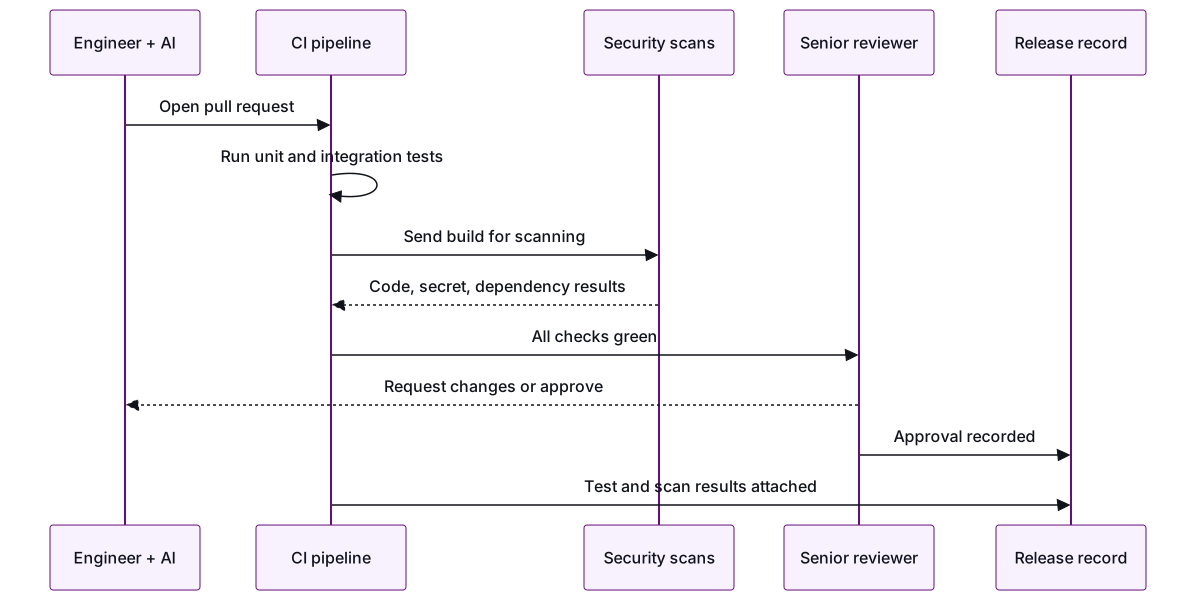
For a step-by-step version of these gates, see how to verify AI-generated code before production.
How is this different from hiring a separate testing vendor?#
A testing vendor checks software after someone else builds it. A quality engineering partner builds the checks into how the software is made and answers for what ships.
The difference shows up in where quality sits and who owns a failure:
| Separate testing phase | Quality engineering inside delivery | |
|---|---|---|
| When quality is checked | After development, before release | On every pull request |
| Who owns a failed release | Unclear; split across a hand-off | The team that shipped it |
| How AI output is handled | Tested like any other build, late | Gated at merge, with dependency and review rules for AI use |
| What you receive | A test report | Tests, gates and a release record in your pipeline |
| How fast feedback arrives | Days after the code was written | Minutes, while the author still has context |
When AI makes changes quicker and smaller, a separate end-of-cycle testing phase becomes the bottleneck. It also lets problems pile up. Quality needs to move to the same place and pace as the code.
What should release evidence contain?#
Release evidence should let someone who wasn't there see what changed, which checks ran, who approved it and how the artifact was built.
A practical release record includes:
- The change: linked pull requests, tickets and the commit range
- Test results: which suites ran, pass/fail counts and any skipped tests with a reason
- Security results: code scan, secret scan and dependency findings, with how each was resolved or accepted
- Approvals: the named reviewer for each change, plus any sign-off needed for risky areas
- Build provenance: how and where the artifact was produced. The SLSA provenance specification defines a standard way to record this, so consumers can check that an artifact was built as expected.
- AI use: which changes were AI-assisted, so reviewers and auditors can see where extra scrutiny went
Standards bodies point the same way. NIST's SP 800-218A adds practices for generative AI and foundation models to its Secure Software Development Framework. That gives security and compliance teams a shared reference when they ask how AI-era code is governed.
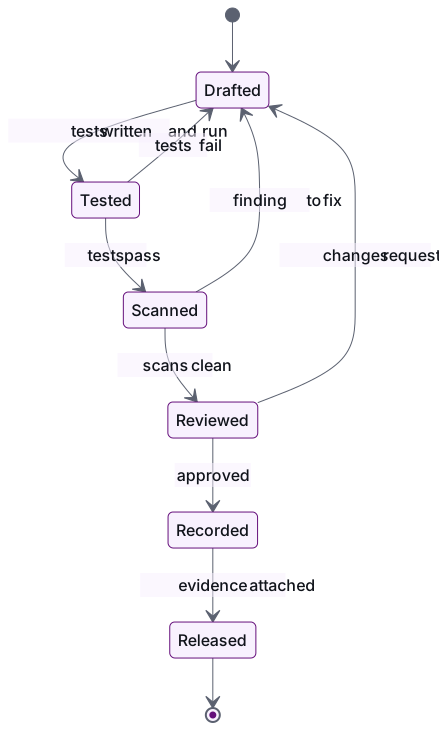
A change only becomes releasable once every check has passed and been recorded:
How do you choose a software quality engineering company?#
Judge a partner on whether it can run these gates on your real codebase and own the result, not on its tool list or headcount.
Ask these questions:
- Do AI-written and human-written changes face the same gates? The answer should be yes, with no exceptions for "small" AI edits.
- Who reviews, and how senior are they? Review only works if the reviewer understands your domain and can say no.
- How do you handle packages an AI suggests? Look for existence checks, an approved list and a named owner for exceptions.
- How do you know the tests are good? Good answers mention tests built from acceptance criteria and checks that tests fail when they should.
- Can you show a release record? Ask for a sample, or better, produce one in a pilot.
- Where do your engineers sit? Same stand-ups and channels as your team means feedback in hours, not in a weekly report.
- How do we start and stop? A paid pilot with success criteria agreed up front tells you more than any proposal.
Red flags:
- Quality described as a phase that runs after "dev complete"
- Coverage percentages offered as the main proof of quality
- No answer on who is accountable when a defect reaches production
- A long contract required before you've seen working software
Our guide to what a paid software vendor pilot needs shows how to scope the pilot and set criteria for scaling up or stopping.
How does Calidad approach quality engineering?#
At Calidad, quality engineering is part of how every pod builds, not a separate service run at arm's length.
Calidad is Spanish for quality, and our working model reflects that. AI does much of the writing. Our engineers make sure what ships is right. In practice, that means:
- Three gates on every release. Tests prove it works. Security checks prove it's safe. A senior engineer's review proves it's right. Nothing ships without all three, whether a person or an AI wrote the change.
- A full system, end to end. Our Quality Engineering service covers reviewed AI-generated tests, code review gates, security and regression checks, and release evidence.
- Embedded, not handed off. Engineers join your experts in the same stand-ups, channels and goals. Teams agree shared rules for code review, tests, AI tool use and definition of done, and check them every sprint.
- Proof before scale. Engagements start with a paid pilot: one pod, one outcome, success criteria agreed up front, judged on working software. There are no long-term contracts.
Our teams are based in Ahmedabad and Bengaluru, India. We work with enterprises, product companies and GCCs in the US, UK, Europe, Singapore and Africa.
Conclusion#
When AI writes the code, quality engineering decides whether that speed turns into reliable releases or faster incidents. The job is concrete: reviewed tests, enforced security and dependency checks, senior review and a release record for every change. The right partner owns those gates inside your team and proves it on your codebase before you commit.
Want to see these gates run on your own code? Talk to an engineering lead →
Frequently asked questions
What is the difference between quality engineering and software testing?
Testing checks whether a specific build works. Quality engineering designs and runs the whole system that proves each change is safe to ship: the tests, security checks, review gates and release evidence. When AI writes much of the code, that system has to run on every pull request, not once before a release.
Can AI tools review AI-generated code on their own?
AI reviewers are useful for spotting common patterns like injection risks or hard-coded secrets. They are weaker on business logic and authorization, where a missing check can expose other customers' data. A dependable setup uses AI review alongside fixed scanners and a senior engineer who must approve each change.
What is a hallucinated package, and how do you stop one reaching production?
It's a dependency an AI model suggests that doesn't exist in the public registry. Attackers can register those names with malicious code. The fix is a pipeline check that confirms each new package exists and is on an approved list before it is installed. Any exception needs a named owner.
How long does it take to put quality gates in place on an existing codebase?
It depends on how much test coverage and pipeline automation you have today. A practical approach is to start with one team or service in a pilot, enforce the gates there and measure the effect before rolling out further. That gives you a working example and a sample release record rather than a plan on paper.
Do quality gates slow down AI-assisted delivery?
Fast, automated gates add minutes to a pull request. They save the days lost to fixing defects found late or in production. The 2025 DORA research found that AI amplifies a team's existing practices, so strong gates are what let faster code-writing lead to faster, safer releases.
What is quality engineering for AI-assisted development?
It is the set of checks that every AI-written change must pass before it ships: automated tests, security and dependency scans, a senior engineer's review, and a release record showing all three happened. It runs inside the delivery team on every change, not as a testing phase at the end.
- quality engineering
- AI-generated code
- software testing
- code review
- software supply chain security
- release management
Newsletter
Get new articles by email
A short monthly round-up of what we've written on engineering pods, quality and AI. No spam.
