
Build-operate-transfer (BOT) in India is a contract where a partner sets up your capability center, runs it for an agreed period, then hands you the entity, people and processes. It works when you're sure you want a large center you own and the contract fixes the transfer price and timing up front. If you're not sure, grow pod by pod first.
What is a build-operate-transfer model for a GCC in India?#
BOT is a way to own an India Global Capability Center (GCC) without building one from scratch yourself. A partner sets it up and runs it for an agreed period, then you buy it out on terms agreed at the start.
Plenty of companies have taken this route into India. The Nasscom-Zinnov GCC Landscape report for FY2026 counts 2,117 GCCs across 3,728 units. That includes 583 mid-market GCCs and 504 PE-backed GCCs, with data as of March 2026. Many of the mid-market and PE-backed companies don't have in-house teams to set up a foreign entity, which is the gap BOT fills.
There are two common ownership structures. Which one you pick shapes every clause that follows:
- Partner-owned entity. The partner incorporates the Indian company and employs the staff. At transfer, you buy the shares, so the employer stays the same.
- Your entity, partner-operated. You incorporate your own subsidiary from day one. The partner runs hiring, payroll and operations under a services agreement. At transfer, you take over management, and staff may move between employers. From day one your subsidiary bills your parent company, so Indian transfer pricing rules apply.
Both routes bring FEMA filings. When the Indian company issues shares to you, it reports them to the RBI on Form FC-GPR within 30 days. When you buy shares from the partner, the deal is reported on Form FC-TRS within 60 days. Then an annual FLA return is due each July. If your company's owners are in a country that shares a land border with India, the investment needs government approval first.
Either way, the Indian company needs a resident director. Under Section 149(3) of the Companies Act, 2013, every Indian company, wholly foreign-owned subsidiaries included, needs at least one director who stays in India for at least 182 days in each financial year (April to March). In the year a company is set up, this applies pro rata. Decide who fills that seat during the operate phase and after transfer.
What happens in the build, operate and transfer phases?#
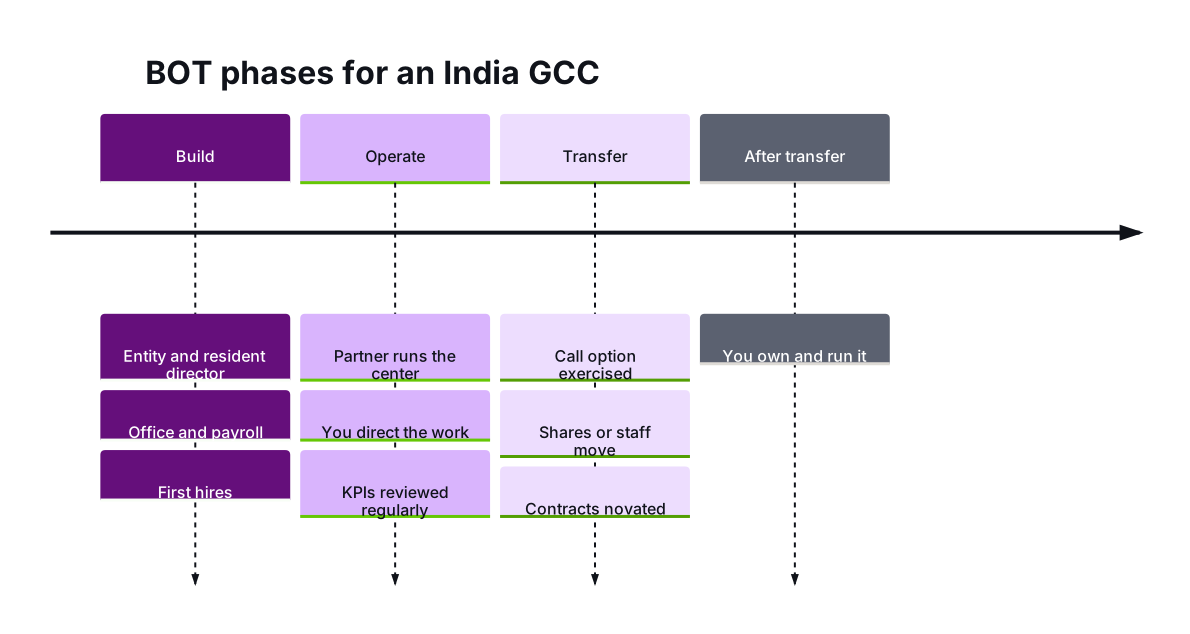
The partner builds the center, then runs it while you direct the work. You exercise an option to take over, and the partner moves the shares or the staff to you.
Build. The partner incorporates the entity or helps you do it. It also arranges office space, payroll, benefits and IT, and hires the first leaders and engineers. Your job is to set the mandate: which workstreams move to India, and what "working" looks like.
Operate. The partner employs or manages the team and handles HR, compliance and facilities. Your product and engineering leaders set priorities and review output. The phase lasts as long as the contract says, and that should be long enough for the center to run without the partner.
Watch permanent establishment (PE) risk in this phase. If your staff work from the center, or the partner's people act for your company or work under your direct control, Indian tax officers may say your foreign company has a taxable presence in India. Keep contracts signed and work accepted outside India, and get tax advice before seconding anyone. Courts have recently taken a strict view of secondments.
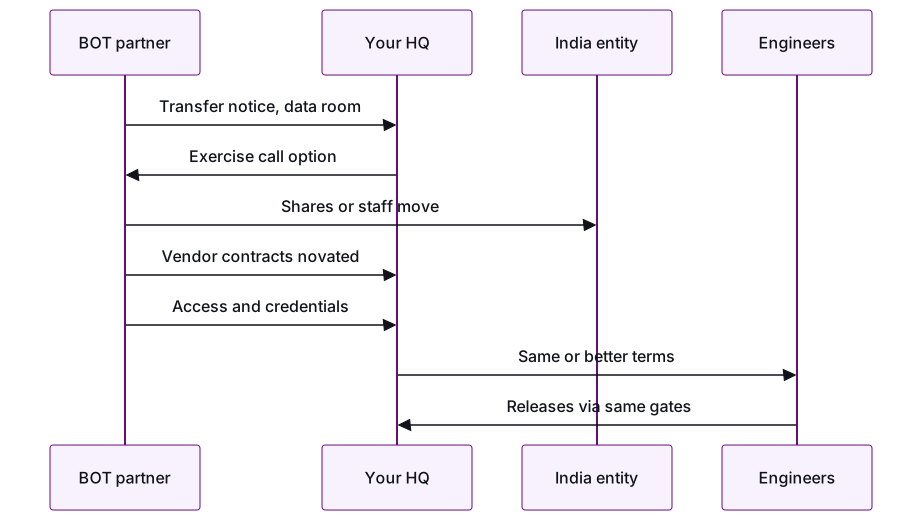
Transfer. You give notice and exercise your call option. Then the shares or staff move, and vendor contracts, leases and registrations are novated or reissued. After that, the partner's role ends or becomes a short support agreement.
Which clauses matter most in a BOT agreement?#
The clauses that matter most decide when you can take over, what you pay and what happens to your people. If those are vague, you're negotiating them at the moment you have the least leverage.
| Clause | What to pin down | Why it matters |
|---|---|---|
| Transfer trigger | A call option with earliest and latest exercise dates, and whether you can bring it forward | Stops the partner from stretching out the operate phase |
| Transfer price | A formula (for example, net assets plus a fixed fee), not "to be agreed", with a floor at fair value on the exercise date | You can't negotiate a fair price once you depend on the partner. FEMA pricing rules apply when a foreign buyer buys Indian shares, and a price below fair value can be taxed in India |
| Employee transfer | Who the employer is at each stage, and a commitment to the same or better terms | Indian law attaches conditions to employee transfers (see below) |
| IP and work product | All code, documents and tooling assigned to you in writing as they are created, worldwide and for the full term of copyright, with the same terms flowing down from the partner's staff and contractors | Avoids paying again at transfer for work you already funded. Under Indian law, an assignment that doesn't state its term and territory lasts only five years and covers only India |
| Non-solicitation | What each side can and can't do about hiring the other's staff, checked by Indian counsel | Leaders the partner hired may be the people you most want to keep |
| Shared services | A list of the partner's systems the center depends on (HRMS, IT, security), with exit help | These are the things that break on transfer day |
| Step-in and termination | Your rights if KPIs slip or the partner fails | You need a way out before the scheduled date |
| Governance and reporting | KPIs, reporting rhythm and audit rights | Lets you judge the center on evidence, not status reports |
The employee clause needs the most care. Section 73 of the Industrial Relations Code, 2020 applies when ownership or management of an establishment changes hands. Workers with at least a year of continuous service are owed notice and compensation as if they'd been retrenched, unless three things are true:
- their service is not interrupted
- their new terms are no less favourable
- the new employer counts their past service if it later retrenches them
These statutory protections cover "workers". That usually includes engineers but not managers, or supervisors earning more than ₹18,000 a month. For staff outside that definition, the employment contract decides. Get Indian employment counsel to map both groups before you sign.
What drives the cost of BOT compared with a pod-by-pod build?#
With BOT, you pay to set up the center, then a management fee while the partner runs it, then a transfer price. With pod-by-pod, cost grows one pod at a time, and each new pod follows work the earlier pods have already delivered.
The main cost drivers in a BOT:
- Setup: incorporation, office fit-out, recruitment fees and equipment, often paid before any work ships.
- Operate-phase fee: usually a markup or management fee on top of salaries and running costs, for the whole operate period. A fee from an Indian partner carries 18% GST, which your entity can usually claim back. If the center is your own subsidiary, what it charges your parent company must meet Indian transfer pricing rules (see below).
- Transfer price: whatever the formula produces, plus tax and legal costs. Buying shares has no GST, but the seller pays capital gains tax, and if the seller is outside India you must withhold tax from the payment. Buying the business as a going concern is GST-exempt; buying assets one by one is not. Add stamp duty, and the gratuity and leave owed to staff who move.
- Hidden duplication: your own leaders' time spent supervising the partner, and systems you replace after transfer.
- Ramp-up risk: headcount you pay for while new hires learn your domain.
A pod-by-pod build moves most of that risk around. With a GCC pod and BOT model in India from Calidad, pods are added only after the existing ones have shown output, and you can add a BOT option later. Pricing is on request. You still pay for the team you have, but not for a center sized for work that hasn't arrived yet.
What tax rules apply to a BOT GCC in India?#
- Law in force. From 1 April 2026, the Income-tax Act, 2025 and Income-tax Rules, 2026 replace the 1961 Act and 1962 Rules. Older articles cite section numbers that no longer apply.
- Transfer pricing. Once you own the Indian company, what it charges your parent must be at arm's length, with a yearly report. Before that, while an unrelated partner employs the team, transfer pricing doesn't apply.
- Safe harbour. For IT and IT-enabled services up to ₹2,000 crore a year, the tax department accepts a margin of 15.5% on operating costs (Income-tax Rules, 2026, Form 49). The choice covers five years.
- GST. Services billed to a foreign company are usually zero-rated exports under a Letter of Undertaking, with no GST charged.
- Corporate tax. An Indian subsidiary on the concessional rate pays about 25%. Dividends paid to your parent are taxed again in India at the treaty rate.
Check how each of these applies to you with an Indian tax advisor.
Where do BOT engagements usually go wrong?#
Most BOT problems trace back to two things: hiring ahead of real work, and a transfer that was never rehearsed. Common failure points:
- Headcount before mandate. The partner hires to a target number, and the team spends months on work that doesn't matter yet.
- Leaders loyal to the partner. The people the partner hired to run the center may not stay through the transfer.
- Attrition at transfer. If benefits, titles or tools change on transfer day, people leave just when you need continuity.
- Price disputes. "Fair market value" with no formula becomes a negotiation you have to win.
- Shared services that don't move. Payroll, identity management, security tooling and licences sat on the partner's contracts.
- Quality drift. Distance is the bigger risk, not talent. Without shared context, tools and release standards, the India team's output differs from headquarters'.
When is pod-by-pod a better fit than a full BOT?#
Pod-by-pod fits better when you haven't yet proven which work belongs in India, or when you'd rather grow cost in steps than pay for a fully built center up front. BOT makes more sense once the mandate is clear, you need a large team quickly, and you don't have the in-house expertise to set up an entity.
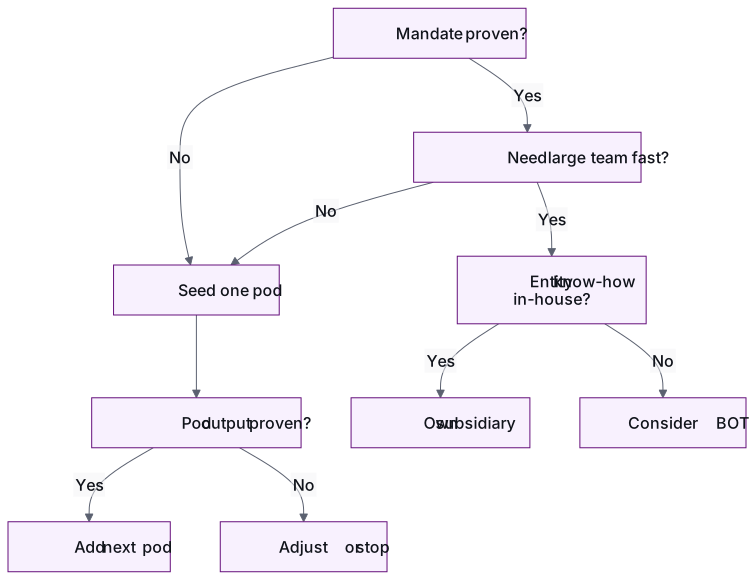
In a pod-by-pod build, a small senior pod takes over a real workstream from headquarters and sets the working norms that later pods inherit. Then you add pods along with the operating model, reporting and quality standards. AI is built into engineering and quality work, with engineers accountable for everything that ships. Each phase has to pass a check before the next one starts. Our guide to setting up a GCC in India pod by pod covers those checks in detail.
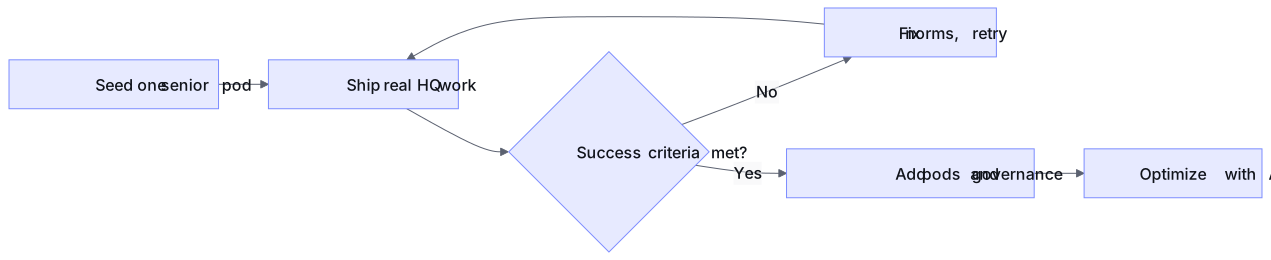
The two approaches can work together. If seeded pods prove the mandate, you can then decide on an entity, and you'll know what the center does before you commit to owning it. To set up that first test properly, see what a paid software vendor pilot needs.
How do you keep quality and governance consistent through the transfer?#
Own the release standards and operating rhythm yourself from day one. Then the transfer changes who pays the team, not how the team ships.
In practice:
- One set of release gates. Every change gets tests, security checks and senior review, whether a person or an AI wrote it. Use the same gates at headquarters and in India. Our guide to verifying AI-generated code before production sets them out.
- Your tools, your accounts. Keep repositories, CI/CD, cloud accounts and ticketing under your tenancy from the start, so there's nothing to migrate.
- Shared rituals. Same stand-ups, channels and definition of done as headquarters, not a separate process for "the offshore team".
- Release evidence. Keep a record of what was tested, scanned and approved for each release. It's the proof that quality held through the change.
- A rehearsed handover. Run a parallel period where your leaders run the center while the partner is still contracted.
Conclusion#
BOT is a reasonable route to an India GCC you own, as long as the contract fixes the transfer date, price formula, employee terms and IP before you sign. Without those, it gets expensive at the point where you have the least leverage. If you're still working out what the center should do, start with one pod, prove the output, and scale from there.
Teams in Ahmedabad and Bengaluru, working with your headquarters, can help you test that before you commit. Talk to an engineering lead →
Frequently asked questions
How long does a BOT engagement in India usually last?
There's no legal standard. The contract sets the length of each phase and the exercise dates for the call option. Set an earliest and a latest transfer date, and make sure the operate phase is long enough for your own leaders to run the center without the partner. Plan for the handover itself taking several months of preparation.
Do employees automatically move to my company at transfer?
It depends on the structure. If you buy the shares of the partner's Indian entity, the employer stays the same and contracts carry on. If staff move from the partner's entity to yours, each person has to agree to the move. Where the whole establishment changes hands, Section 73 of the Industrial Relations Code, 2020 gives workers with a year's service notice and retrenchment compensation, unless their service is unbroken, their terms are no less favourable, and the new employer takes on their past service. Agree up front who pays gratuity and leave balances. Get Indian employment counsel to review the plan.
Can I keep full control of an Indian subsidiary if I need a resident director?
Yes, structurally. Section 149(3) of the Companies Act, 2013 requires at least one director who stays in India for 182 days or more in each financial year, pro rata in the year the company is set up. That's a rule about board composition, not about control. The resident director does owe duties to the Indian company and can be liable for its defaults, so choose that person carefully.
Is pod-by-pod just outsourcing with a different name?
No. In a pod-by-pod build, each pod works inside your team with the same stand-ups, channels and release gates as headquarters, and it owns a real workstream. New pods are added only after the existing ones have shown output. The aim is a capability center that shares your context and quality bar, not work handed over a wall.
Can I start pod by pod and set up my own entity later?
Yes. Seeding pods first lets you prove which work belongs in India before you take on the cost of incorporating and running an entity. When you do set one up, you'll know what the center does, how many people it needs and which standards it already follows.
Is build-run-transfer the same as build-operate-transfer?
Yes. Build-run-transfer and build-operate-transfer (BOT) are two names for the same model: a partner sets up your global capability center (GCC) in India, runs it for an agreed period, then transfers the entity, people and processes to you.
- GCC
- Build-Operate-Transfer
- India
- Global Capability Center
- Offshore Engineering
Newsletter
Get new articles by email
A short monthly round-up of what we've written on engineering pods, quality and AI. No spam.
