
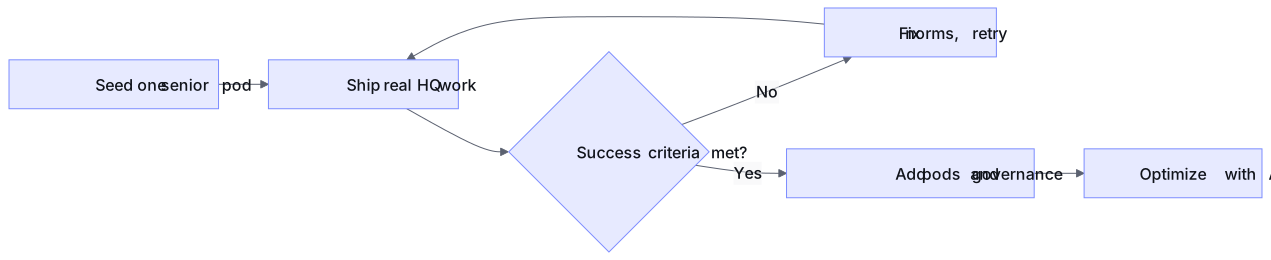
The lowest-risk way to set up a GCC (Global Capability Center) in India is to build it in phases. Start with one senior pod working on a real workstream from headquarters. Check that it ships to your quality bar. Then add pods along with governance, reporting and release standards. Use AI to raise output only after that. Each step should be earned by output you've already seen, not planned headcount.
What is a Global Capability Center, and when does one make sense?#
A GCC is an engineering or operations unit in another country that your company owns and runs, rather than a vendor you rent. Wikipedia defines a GCC as an offshore or nearshore entity set up by a multinational to tap costs, people or technology available in other places.
India is the default location for most companies, and the market is large. The Zinnov-Nasscom FY2026 landscape report counts 2,117 GCCs in India. They employ 2.36 million people and earn $98.4 billion in revenue. GCCs aren't only for the Global 2000 anymore: the same report counts 583 mid-market GCCs and 504 backed by private equity.
A GCC usually makes sense when:
- You have a product or platform roadmap that runs for several years, not a one-off project.
- You want the people who build your software to stay, so knowledge of your systems keeps growing.
- Headquarters can spare real leadership time for at least the first year.
- The work needs ongoing ownership: features, platforms, quality, data, on-call.
If the roadmap is short or unclear, a project team or a dedicated team is often a better first step.
Why do so many GCCs struggle with distance and domain context rather than talent?#
Talent is rarely the problem. The trouble is that the context lives at headquarters, and distance makes every gap in context cost more.
When companies set up a GCC in India, the same four problems come up again and again:
- Ramp-up risk. Building a center from scratch is expensive before anything ships.
- Slow domain learning. New teams take a long time to understand the business well enough to make good decisions on their own.
- Time-zone delay. When a question can only be answered by someone asleep at headquarters, it costs a day.
- Quality drift. The center ends up with a different definition of "done" from headquarters.
Turnover makes all four worse, because context leaves when people do. Taggd, citing the India Decoding Jobs Report 2026, puts attrition in this segment at 18–25%. A center built on hand-offs and tickets has to relearn the domain every time someone leaves. A center built around ownership keeps what it has learned.
What does a pod-by-pod GCC setup look like, phase by phase?#
Pod-by-pod means you grow the center one small team at a time, in three phases. Each phase has to work before the next begins.
Phase 1: Seed one pod. A small, senior pod takes over a real workstream from headquarters, not a sandbox project. It sets the working habits every later pod will follow: how reviews work, the definition of done, how questions get raised and how releases go out.
Phase 2: Scale teams and governance. Add pods one at a time. Each new pod joins work that already ships and comes with the operating model, reporting and quality standards the first pod proved.
Phase 3: Optimize with AI. Build AI into engineering and quality work across the center. Engineers stay accountable for everything that ships.
The rule that runs through all three phases: headcount follows proven output, never the other way round.
How does pod-by-pod compare with a full build-operate-transfer model on risk and cost structure?#
The main difference is when you commit. Build-operate-transfer (BOT) commits you to the full center up front. Pod-by-pod spreads the commitment out and ties each step to output you've seen. For the contract clauses, employee transfer rules and tax points, see our guide to build-operate-transfer in India for GCCs.
In BOT, a partner builds the center, runs it for a defined period, often 18–24 months, then hands it to you. It works well if you're sure you want to own a center of a known size. But the handover is a big event in its own right: employment continuity, gratuity, IP ownership, FEMA, transfer pricing, GST and permanent-establishment exposure all need planning.
| Factor | Full build (BOT or self-build) | Pod-by-pod |
|---|---|---|
| First commitment | Entity, office, hiring plan for the full center | One senior pod on one workstream |
| When real work starts | After setup and hiring | With the first pod |
| What triggers hiring | A planned headcount ramp | Output you've already seen |
| Main risk | Paying for capacity before the model is proven | Slower headline headcount early on |
| Cost structure | Large fixed costs up front | Costs grow in steps, pod by pod |
| Changing course | Expensive once the center is built | Resize pods as priorities change |
| Governance | Designed on paper before it's tested | Tested on live work before it's scaled |
You don't have to pick one or the other. Many leaders seed and prove the model pod by pod, then decide on entity structure once they know what the center will actually do. If owning the entity eventually is part of the plan, get legal and tax advice on structure early.
What governance, reporting and quality standards should be in place before you scale?#
Write down and test five things with the first pod before the second one starts.
- Operating model. Who decides what, how things escalate, and which decisions the center can make without headquarters.
- Reporting on outcomes, not hours. The latest Nasscom-Zinnov report names measuring business outcomes instead of operational metrics as one of four steps for GCCs to mature. Report on features shipped, defects that escaped, and lead time.
- Quality standards. A shared definition of done, rules for code review and tests, and rules for using AI tools.
- Data and access rules. Decide which systems and data the center can touch. If personal data is involved, India's DPDP Rules were notified in November 2025. Most duties under the Digital Personal Data Protection Act, 2023 apply from May 2027, and a few apply earlier. Data about people outside India, processed under a contract with your foreign company, is partly exempt. Data about the center's own staff is not. Check your obligations with counsel.
- An onboarding playbook. Everything the first pod learned about the domain, written down so pod two ramps faster than pod one did.
How do you keep one quality bar between headquarters and the India center?#
Run the same pipeline, the same release checks and the same rituals in both places. Don't put a separate "offshore QA" step on top.
In practice:
- Three gates on every change. Tests show it works, security checks show it's safe, and a senior engineer's review shows it's right. This applies whether a person or an AI wrote the change. Our post on how to verify AI-generated code before production goes through each gate.
- One CI/CD pipeline. If headquarters and the center ship through different pipelines, their standards will drift apart.
- Shared rituals. Same stand-ups, same channels, same goals. If decisions are only made in headquarters meetings, the center never gets the full context.
- Review in both directions. Center engineers review headquarters code too, not just the reverse.
- Release evidence. Keep a record of what was tested and checked for each release, so quality can be checked rather than assumed. Our Quality Engineering service builds this.
How do you choose between Ahmedabad, Bengaluru and other Indian cities?#
Pick the city whose talent pool fits the work you're moving, then weigh how hard it is to compete for that talent.
An Inductus/D&B Bengaluru edition report, drawing on Zinnov, AMCHAM India and Nasscom data, shows how GCC units are spread across India. Bengaluru has 30%, NCR 16%, Hyderabad, Pune and Mumbai 12% each, Chennai 10%, and emerging cities 8%.
- Bengaluru has the deepest pool of engineering, product and AI talent. It also has the most GCCs competing for the same people.
- Ahmedabad is a strong second-tier option. Zinnov ranked the Ahmedabad–Gandhinagar–GIFT City corridor first in ecosystem favorability among 20 Tier-II cities in 2024. Its financial-services cluster around GIFT City matters if you're in fintech or financial services.
- Hyderabad, Pune, NCR and Chennai each have their own industry strengths.
When choosing, ask: does this city have senior people in your stack and domain? How fierce is local competition for them? Can headquarters staff get there easily? Does your partner already have teams there?
We have teams in Ahmedabad and Bengaluru, so a center can start in either city and grow across both.
What should the first pod deliver before you commit to scaling?#
Working software in production, on a real headquarters workstream, judged against success criteria agreed before the pod started. Slides and status reports don't count.
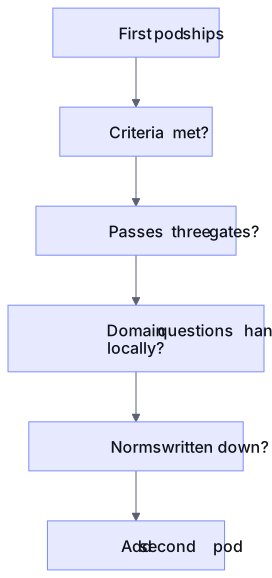
Before you scale, check that the first pod has:
- Shipped to production on work headquarters cares about.
- Passed every gate (tests, security checks, senior review) without headquarters catching problems after the fact.
- Built domain judgment. Fewer questions need to wait overnight for headquarters to answer.
- Written its norms down, so the next pod can pick them up.
- Met the agreed criteria, judged by your engineering leaders.
If any of these is missing, fix it with this pod before hiring the next one. Adding people to a model that doesn't work yet only spreads the problems.
Conclusion#
Setting up a GCC in India goes best when each decision has evidence behind it. Seed one senior pod on real work. Write down and test governance, reporting and quality standards before the second pod arrives. Run one quality bar across headquarters and the center. Add AI once the basics hold. With this approach, ramp-up risk stays low and the first pod ships while the rest of the center is still being hired.
To see how a first pod works, what it costs and how you can take it over later, see GCC pod in India.
Planning a GCC and want to test the model on live work first? Talk to an engineering lead →
Frequently asked questions
How long does it take to set up a GCC in India?
It depends on the route you choose. In BOT setups, a partner [typically runs the center for 18–24 months](https://tmservices.co.in/gcc-bot-model-india/) before handing it over. With pod-by-pod, a senior pod can start on real work while the rest of the center is still being hired, so value comes before full setup.
Do we need our own legal entity in India from day one?
Not to start proving the model. A partner pod can take on a real workstream first. Keep the contract clear that the partner employs and manages the team, so your company doesn't create a taxable presence in India by accident. If you plan to own the center eventually, get legal and tax advice early. Entity structure, IP ownership and transfer terms are [harder to fix later](https://remunance.com/blog/build-operate-transfer-model/).
What kind of team should the first pod be?
A small, senior pod that can own a slice of the roadmap from start to finish. That typically means an engineering lead plus full-stack, QA/automation, DevOps and product skills. Seniority matters most here, because the first pod sets the habits every later pod inherits.
Can an India GCC work in US or European hours?
Yes, if you plan for it. Teams can work in your time zone, and shared stand-ups and channels keep questions from waiting overnight. More importantly, give the center enough domain context to make decisions without headquarters.
How does AI change the way you build a GCC?
Per the Zinnov–Nasscom report, [nearly half of GCCs set up since FY2021](https://yourstory.com/enterprise-story/2026/05/gccs-number-touch-2117-in-india-revenue-just-short-of-100-billion) were built with AI as a core focus. AI raises output per pod, but it also raises the volume of code that needs checking. Keep tests, security checks and senior review on every change, and keep engineers accountable for what ships.
- GCC
- Global Capability Center
- India
- Offshore Engineering
- Build-Operate-Transfer
- Engineering Governance
Newsletter
Get new articles by email
A short monthly round-up of what we've written on engineering pods, quality and AI. No spam.
