
An enterprise AI strategy roadmap is a short list of decisions, not a vision deck. It names the two or three use cases you will fund, the baseline metric each one has to beat, and whether to build, buy or call an API. It confirms the data is ready and you're allowed to use it, sets the governance rules, and lays out a 90-day plan with named owners and stop criteria.
This post goes through each of those decisions in the order we make them. It follows the deliverables of our AI Strategy consulting, and it's written by engineers who also build the generative AI apps and agents that come out of it.
Why do most enterprise AI strategies stall after the vision deck?#
They stall because they set out ambitions without making decisions. Nothing has a baseline to beat, nobody owns the result, and there is no agreed reason to stop.
The industry numbers show the cost. Gartner predicted that at least 30% of generative AI projects would be abandoned after proof of concept by the end of 2025. The reasons it gave were poor data quality, weak risk controls, rising costs and unclear business value. The same release put the cost of some GenAI deployments at $5 million to $20 million, so an unclear business case gets expensive.
The same patterns show up in most enterprises we talk to:
- Parallel pilots with no baseline. Every team runs its own experiment, and none of them can say what "better" means.
- Platform before problem. Vendors pitch platforms before anyone has named the decision AI is supposed to improve.
- Late data surprises. Teams find out the data is scattered, stale or off-limits only after the budget is spent.
- No shared rules. Legal, security and leadership disagree on what AI is allowed to touch, so every rollout becomes an argument.
Each section below answers one of these problems with a decision you can write down.
How do you rank AI use cases by value, frequency, data access and risk?#
Score every candidate on four criteria against a measured baseline. Then fund only the two or three at the top that have a number to move.
| Criterion | Question to answer | Strong score looks like |
|---|---|---|
| Value | What does one improvement save or earn? | A cost, revenue or risk figure you can tie to a P&L line |
| Frequency | How often does the task happen? | Thousands of times a month, not a few times a quarter |
| Data access | Can the system reach the data it needs, legally and technically? | The data is in known systems, has an owner and is cleared for this use |
| Risk | What happens when the AI is wrong? | A person reviews the output, or a mistake is cheap and easy to undo |
Multiply value by frequency to get the size of the prize. Treat data access and risk as gates rather than bonus points: a high-value idea with blocked data is a data project, not an AI project.
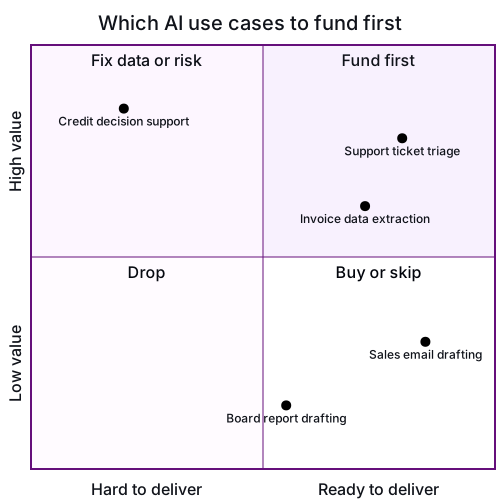
Here's a typical spread. Support ticket triage happens often, uses data you already hold, and a wrong route is cheap to fix. Credit decision support may be worth more, but a wrong answer affects a real person, so it needs much more control before you fund it. Board report drafting is easy to build and moves very little.
How do you set a baseline metric before any pilot starts?#
Measure how the process performs today, on the exact metric the AI is supposed to move, before anyone writes a prompt. A pilot without a baseline can only produce opinions.
- Pick one metric per use case. For ticket triage, that could be median time to the correct queue plus the misroute rate. Two metrics at most.
- Measure the current process the same way you'll measure the pilot. Use the same data source, the same definitions and the same time window. If you can, run it for a few weeks so you catch normal variation.
- Record what the current process costs. Count people-hours, rework and errors. Later you'll compare this against the AI's cost per transaction.
- Write down a target and a stop threshold. The target is the improvement that justifies scaling. The stop threshold is the result that ends the project. Both get signed before the pilot starts.
For more on tying each investment to a metric and a board-level scorecard, see our guide to measuring digital transformation value.

How do you decide whether to build, buy or call an API?#
Buy when the task is a commodity and the vendor meets your data rules. Call a model API from your own stack when the value depends on your data and workflows. Build custom only when the capability sets you apart from competitors and you can afford to evaluate and maintain it.
| Option | Fits when | You own | Main cost drivers |
|---|---|---|---|
| Off-the-shelf tool | The task is generic (meeting notes, writing help) | Configuration and access rules | Per-seat licences, vendor lock-in |
| Model API on your stack | Answers must come from your documents, records or screens | Retrieval, permissions, guardrails, evaluations | Tokens per request, integration work |
| Custom build | The behaviour is a competitive difference | All of it, including model choice and fallbacks | Engineering time, evaluation upkeep, run costs |
Write down the cost of each option for each use case. Include running costs as well as build costs.
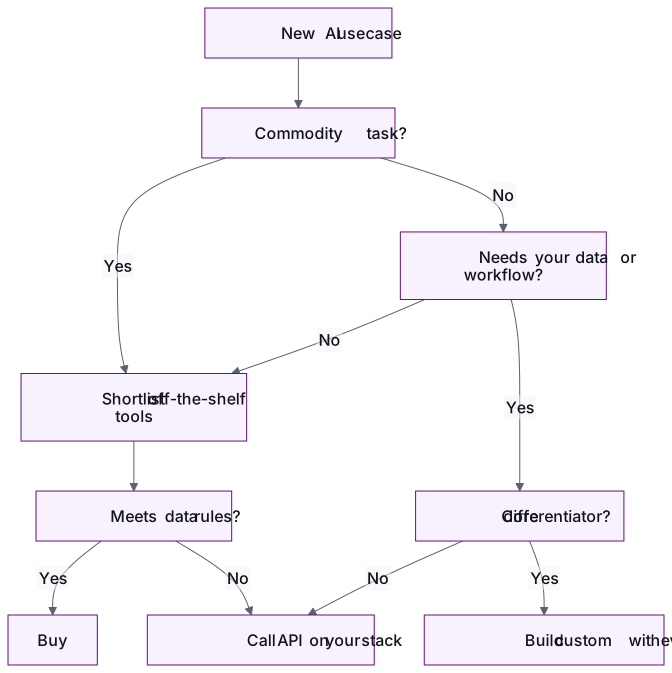
Whichever path you pick, write the evaluation set first. That means scored test questions taken from real user requests, written before you choose a model or a prompt. It's how our generative AI apps team works. It turns every later model swap or prompt change into a measured comparison instead of a guess. Also set a latency and cost budget per request before usage grows.
How do you check data readiness before committing budget?#
Before you fund a use case, answer four questions about the data it needs: where it lives, who owns it, how clean it is, and whether you're allowed to use it for this purpose.
This step is where many projects fail. In a Gartner survey, 63% of organizations either didn't have, or weren't sure they had, the right data management practices for AI. Gartner also predicts that through 2026, organizations will abandon 60% of AI projects that lack AI-ready data.
A data-readiness check for each top candidate:
- Location. List every system the use case reads from, how fresh each source is, and how you'll access it (API, change data capture, export).
- Ownership. Name a business owner and a technical owner for each dataset. If nobody owns a table, nobody fixes it when the AI starts relying on it.
- Quality. Sample real records. Check duplicates, missing fields and conflicting versions of the same customer or product.
- Permission. Confirm consent, data classification and access rights. For retrieval-based assistants, permissions need to be enforced when each query runs. Otherwise users can see documents they were never allowed to open.
If a high-value use case fails this check, fix the data first. Our data governance and MDM practice covers this work: ownership maps, data contracts, lineage, and a review of what data models and agents may use.
What should an AI governance policy cover on day one?#
It should be a one-page policy people can actually follow. It names the approved tools, says which data classes each tool may touch, and sets review rules for AI output. It's in place before the first pilot ships, not after the first incident.
Start with an established framework so you aren't inventing structure. The NIST AI Risk Management Framework groups AI risk work into four functions: govern, map, measure and manage. ISO/IEC 42001 is the international standard for AI management systems, for organizations that develop, provide or use AI.
Regulation also shapes the timing if you operate in the EU. The EU AI Act's prohibited practices and AI literacy duties have applied since February 2025, and its transparency obligations since August 2026. The Digital Omnibus on AI moved compliance for standalone high-risk systems to 2 December 2027, and for AI built into regulated products to 2 August 2028. That's a deferral, not a cancellation, so classify your use cases now.
A day-one policy covers:
- Approved tools. Which assistants, models and APIs are allowed, and at what tier.
- Data rules. Which data classes (public, internal, confidential, personal) each tool may receive.
- Review requirements. AI-written code goes through tests, security checks and senior engineer review before release. AI agents need a person to approve risky actions and must keep a full audit trail.
- Use-case register. Every AI system, with its owner, risk tier and the data it uses.
- Incident path. Who gets told, and who can switch a feature off.
What does a 90-day AI roadmap with owners and stop criteria look like?#
It's three 30-day phases: prepare, pilot, decide. Each milestone has a named owner, and each phase has a written condition that ends the work if it isn't met.
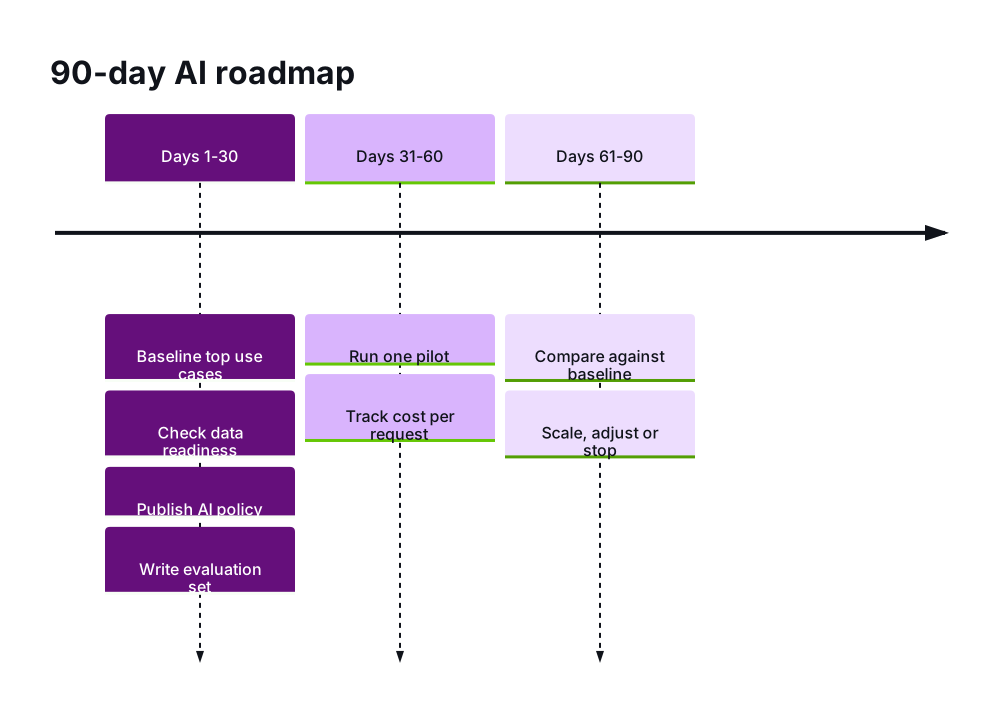
Give every milestone three owners:
- Business owner. Accountable for the metric and for signing off the decision.
- Technical owner. Accountable for the build, the evaluation set and running costs.
- Risk owner. Accountable for data clearance and policy compliance.
Write the stop criteria before day one. For example:
- Data access for the top use case isn't cleared by day 30: switch to the next-ranked use case.
- By day 60, the pilot is short of its target on the evaluation set or on live traffic: change one variable at most, or stop.
- Cost per request at expected volume goes over the cost of the current process: stop or redesign.
- By day 90, the business metric hasn't beaten the baseline: don't scale, whatever the demo looked like.
We run the pilot phase as a paid pilot: one pod and one outcome, with success criteria agreed up front. Our guide to what a paid software vendor pilot needs explains how to scope one and how to make the scale-or-stop call.
Conclusion#
An enterprise AI strategy that gets past the deck is one you can audit. It has a ranked shortlist, a baseline for each use case, a written build-or-buy choice with costs, a data-readiness verdict, a one-page policy, and a 90-day plan where every milestone has an owner and every phase has a way to stop. That keeps budget on the two or three bets that can show a number.
If you've been asked to produce an AI strategy and want it built by people who will also build what it recommends, talk to an engineering lead.
Frequently asked questions
How many AI use cases should an enterprise fund in the first 90 days?
Two or three at most, and usually only one goes to pilot in the first 90 days. Each funded use case needs its own baseline, owners and evaluation set, and spreading effort thinner means none of them gets measured properly. The rest of the ranked list waits until the first pilot has reached a scale-or-stop decision.
What is the difference between an AI strategy and an AI roadmap?
The strategy is the set of decisions: which problems to solve with AI, what data to use, which tools are approved, and what you won't do. The roadmap turns those decisions into time-bound milestones with owners and stop criteria. A strategy without a roadmap rarely ships anything, and a roadmap without a strategy usually funds the wrong pilots.
Do we need ISO/IEC 42001 certification before starting AI projects?
No. You can start with a one-page policy covering approved tools, data rules and review requirements, then build toward a fuller management system. Frameworks like NIST AI RMF and ISO/IEC 42001 are useful structures to grow into. Whether you need formal certification depends on what your customers and regulators expect.
What should a stop criterion for an AI pilot look like?
It should be a specific, measurable condition that's written down and signed before the pilot starts. Examples: "misroute rate not below baseline by day 60" or "cost per request at expected volume exceeds the current process cost." It should name who makes the call, so the decision doesn't depend on how impressive the demo looked.
How do you measure whether an AI feature is working after launch?
Run the same evaluation set on every prompt, model or retrieval change, and keep tracking the business metric you set as the baseline. Watch cost per request and response times as usage grows. If answers cite their sources, users and reviewers can check individual responses as well as aggregate scores.
What should an enterprise do in the first 90 days of a generative AI strategy?
Pick two or three use cases with a clear business owner, measure today's baseline for each, decide whether to build, buy or call an API, confirm the data is ready and allowed to be used, and run time-boxed pilots with written stop rules. At day 90, scale what beat its baseline and stop the rest.
- AI strategy
- Enterprise AI
- AI governance
- Data readiness
- Generative AI
Newsletter
Get new articles by email
A short monthly round-up of what we've written on engineering pods, quality and AI. No spam.
