
Legacy application modernization means moving ageing software, such as old Java, .NET or mainframe-adjacent apps, onto platforms your teams can change, secure and run at a sensible cost. To do it well, you assess each app, choose one of seven paths (rehost, replatform, refactor, re-architect, rebuild, replace or retire) and migrate in small steps you can reverse, so the business keeps running.
This guide is the overview. For the step-by-step technical playbooks, see our guides on legacy .NET to cloud-native without downtime and monolith to microservices without downtime.
What does legacy application modernization actually mean?#
It means changing how an application is hosted, built or structured so it stops holding the business back. It does not always mean rewriting it.
An app counts as "legacy" because of how it behaves, not how old it is. Common signs:
- The runtime or framework is out of support, so security patches are slowing or have stopped.
- Few people understand it, and they are close to retirement or already gone.
- Releases are rare and risky: quarterly windows, manual steps, weekend cutovers.
- It can't take part in new work: no APIs, no events, no safe way to expose its data to analytics or AI.
- Running it costs more each year, through licences, hardware, specialist contractors or workarounds.
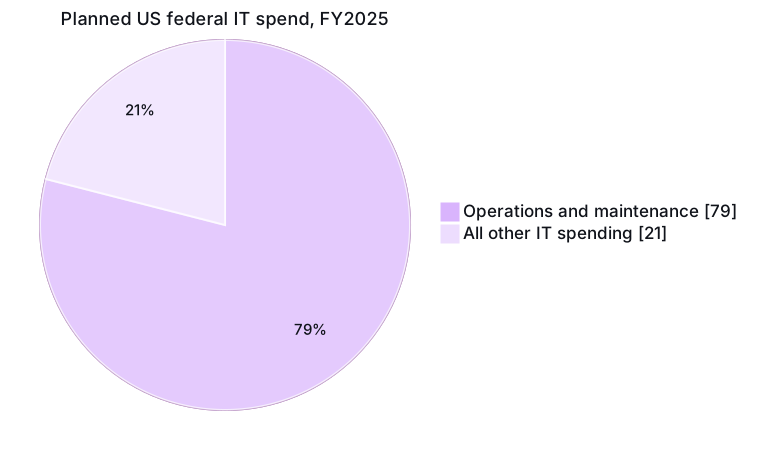
That last point adds up across a portfolio. In its 2025 review of legacy systems, the US Government Accountability Office found that about $83 billion (79%) of planned federal IT spending for fiscal year 2025 was set aside for operating and maintaining existing systems. Enterprises don't publish their numbers the same way, but the pattern is familiar: the more you spend keeping old systems alive, the less you have for new work.
How do you assess which legacy apps to modernize first?#
Score every app on business value and technical risk. Then start with one that matters to the business but can fail safely.
Step 1: Build the inventory. For each application, record its business owner, its users, its upstream and downstream dependencies, the data it owns, its runtime and support end dates, and how often it changes.
Step 2: Score it on six criteria, each from 1 to 5:
- Business criticality: what stops if it goes down?
- Change demand: how much of the roadmap needs this app to change?
- Technical health: runtime support, test coverage, how often it deploys.
- Knowledge risk: how many people can safely change it?
- Data entanglement: how many other systems read or write its database directly?
- Compliance exposure: audit, privacy or regulatory requirements it carries.
Step 3: Plot the results. Value (criticality plus change demand) goes on one axis and technical debt (health, knowledge risk, entanglement) on the other. In the example below, a billing engine is high on both, so it gets modernized in phases. A customer portal is valuable and fairly healthy, so it keeps improving where it is. An internal reporting tool with high debt and low value is a candidate to retire or replace. A staff intranet that is low on both can be left alone for now.
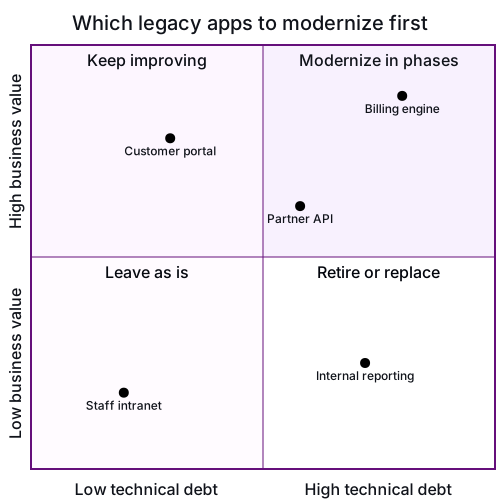
Step 4: Choose the first candidate carefully. Don't start with the riskiest crown jewel. Pick something like the partner API above: valuable enough that success counts, but limited enough that a mistake won't stop revenue. Or pick one well-bounded slice of a crown-jewel system.
Should you rehost, replatform, refactor, re-architect, rebuild, replace or retire?#
Choose the cheapest option that removes the specific problem holding each app back. Most portfolios end up using several options at once.
The terms come mostly from cloud migration frameworks such as AWS's 7 Rs. That guidance makes a point worth borrowing: refactoring during a large migration is the most complex strategy, so AWS recommends moving applications first and modernizing them once the migration is done.
| Option | What changes | Use it when | Effort and risk |
|---|---|---|---|
| Retire | The app is switched off | Usage is low or another system already does the job | Very low |
| Rehost | Infrastructure only ("lift and shift") | Data centre exit, hardware end of life | Low |
| Replatform | Runtime or managed services, with light code changes | Unsupported OS, database or app server | Low to medium |
| Replace | You move to SaaS or a packaged product | The capability is commodity (HR, ticketing, CRM) | Medium; mostly data migration and change management |
| Refactor | Code structure, with the same behaviour | The code can be saved but is hard to change and has few tests | Medium |
| Re-architect | Boundaries, data ownership, deployment model | The structure blocks scaling, team independence or new integrations | High |
| Rebuild | A new codebase built from the original intent | The code and data model can't be saved | Highest |
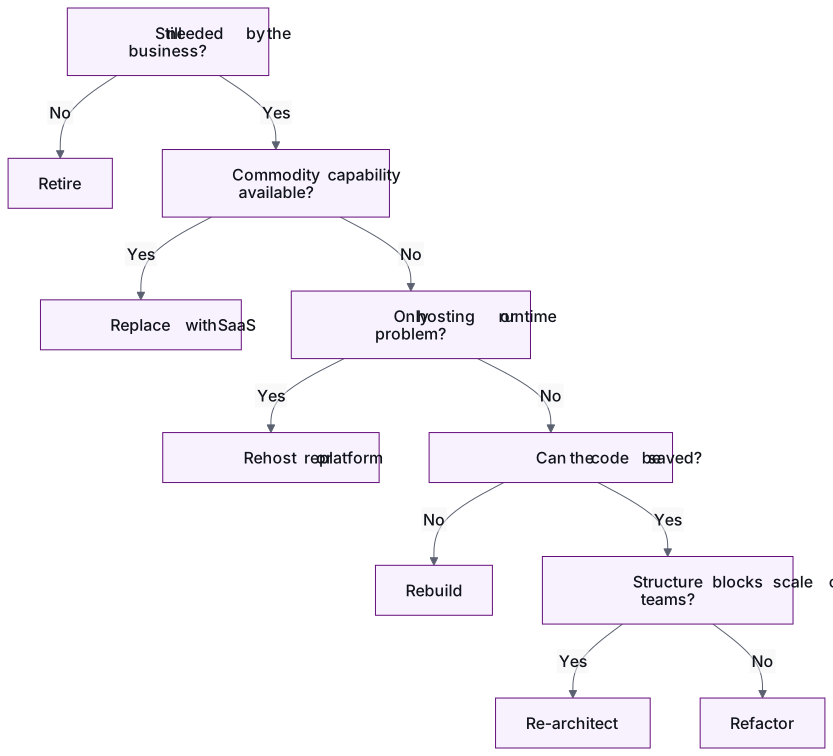
Work through the questions in a fixed order. First, is the app still needed? If not, retire it. Second, is it a commodity you could buy? If so, replace it. Third, is the only problem the hosting or runtime? If so, rehost or replatform. Only after those three questions do you consider changing the code itself.
How do you modernize without downtime or a risky big-bang cutover?#
Put a routing layer in front of the legacy system and move one route or capability at a time. Every move needs a tested way back.
This is the strangler fig pattern. Microsoft's Azure Architecture Center describes it as a façade that routes requests between the legacy and new systems while the migration progresses. It also warns that the façade is transitional architecture with its own temporary costs, so plan to remove it when the migration is finished.
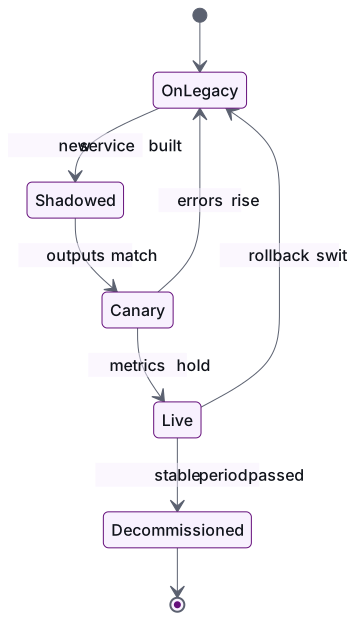
In practice, each slice goes through the same steps:
- Add the façade (a reverse proxy or API gateway) without changing any behaviour.
- Build the new service for one route, with data kept in sync with the legacy database.
- Shadow traffic: send copies of real requests to the new path and compare the outputs.
- Canary: move a small share of live traffic, and watch error rates and latency.
- Switch fully, but keep the legacy path ready so rolling back is just a routing change.
- Decommission the legacy code and data for that route once it has been stable for an agreed period.
Our .NET modernization playbook shows this with a YARP façade and route-by-route migration. The monolith-to-microservices guide covers the hardest part: splitting a shared database with change data capture and expand-and-contract schema changes.
Can AI safely convert legacy code such as Java or .NET, and how do you verify it?#
Yes, AI can speed up conversion considerably. It is only safe when every converted change passes the same tests, security checks and senior review as code a person wrote.
The risk is code that compiles and looks right but is quietly wrong or unsafe. In its Spring 2026 GenAI code security update, Veracode reports that AI models now produce syntactically correct code more than 95% of the time. Their security pass rate, though, has stayed at around 55%. When no security guidance is given, the model introduces a known flaw in 45% of cases. Legacy code makes this harder, because years of undocumented business rules live in edge cases.
A safe workflow for AI-assisted conversion:
- Pin current behaviour first. Write characterization tests against the legacy app (inputs, outputs, side effects) before converting anything.
- Convert in small slices, one module or route at a time, so each review is small enough to read properly.
- Compare old and new on the same inputs, using recorded production traffic where privacy rules allow it.
- Run security and dependency checks on every pull request. Upgraded frameworks bring new packages, and each one needs checking.
- Require senior review of business logic, especially rounding, dates, permissions and error handling.
- Keep release evidence: which tests ran, what the scans found and who approved the change.
We explain these gates in more detail in how to verify AI-generated code before production.
How do you prove modernization is paying off as you go?#
Measure a baseline before the first change. Then report the same few metrics after every phase, alongside an agreed rule for when to stop.
Start with delivery performance. Google's DORA research team identified four key metrics: deployment frequency, lead time for changes, change failure rate and time to restore service. Together they measure both speed and stability. Add metrics specific to modernization:
- Share of traffic or transactions served by the new platform
- Run cost per application, covering infrastructure, licences and support contracts retired
- Legacy footprint removed: servers, databases and code paths decommissioned (not just bypassed)
- Incidents and rollbacks per phase
- Time for a new engineer to ship their first change
Agree a stop rule at the start, for example: "if change failure rate rises for two phases in a row, we pause and fix the pipeline before moving more routes." Modernization that never retires anything just leaves you running two systems.
What should you ask a legacy modernization partner before you sign?#
Ask how they will prove their approach on one of your systems before you commit, and how every release will be verified and reversed if needed.
Questions worth asking:
- How do you assess our portfolio, and who from our side needs to be involved?
- Which option would you choose for our riskiest app, and why not a cheaper one?
- What is the rollback plan for each step, and has it been tested?
- How do you handle shared databases during the move?
- Where do you use AI in conversion, and what gates does AI-written code pass?
- What evidence do we get with each release?
- Can we start with a small paid pilot that has success criteria agreed in writing?
Here is how we answer them. Our Platform Modernization service moves critical legacy systems onto modern, cloud-native platforms while your business keeps running, covering cloud migration, re-architecture, DevOps and data platforms. Our engineers work alongside your subject-matter experts, use AI to move faster, and put every release through three gates: tests, security checks and senior engineer review. That applies whether a person or an AI wrote the change. We start with a low-risk workload so the runbook is proven before anything critical moves, and every step has a rollback plan. Engagements begin with a paid pilot: one pod, one outcome and success criteria agreed up front, with no long-term contract.
Conclusion#
Legacy modernization works as a series of small decisions rather than one big programme. Score each app, choose the cheapest option that removes its real problem, move one slice at a time behind a façade, check every change (especially AI-converted code), and measure progress against a baseline. If you can't roll back a step, it isn't ready to ship.
Have an ageing Java, .NET or mainframe-adjacent portfolio to sort out? Talk to an engineering lead →
Frequently asked questions
How long does legacy application modernization take?
It depends on how many apps you have and which option each one needs. Retiring or rehosting an app is much faster than re-architecting or rebuilding it. Because the work is phased, you should see a first slice running in production long before the whole portfolio is done. A short pilot on one well-bounded workload gives you a realistic pace for planning the rest.
Is rehosting to the cloud enough to modernize an application?
Rehosting fixes infrastructure problems, such as hardware end of life or a data centre exit, but the code and release process stay the same. AWS's guidance recommends moving first and modernizing afterwards on large migrations, so rehosting is often a sensible first step. Plan the follow-up work (replatforming or refactoring) so the app doesn't end up as the same legacy system on new servers.
What's the difference between legacy modernization and cloud migration?
Cloud migration changes where an application runs. Modernization changes how it is built, deployed and maintained, and it may or may not involve the cloud. Many programmes do both: migrate with minimal change, then modernize the apps the business actually needs to change.
Do we have to freeze new features while we modernize?
Not if you migrate incrementally. With a strangler fig façade, the legacy system keeps serving everything that hasn't moved yet, so teams can keep shipping features. New features for a capability usually go into the new service once that capability is being migrated.
How do we keep business rules from getting lost during AI-assisted conversion?
Write characterization tests that capture the legacy system's actual behaviour before converting anything, then run the converted code against the same inputs. Have a senior engineer who knows the domain review the logic around money, dates and permissions. Without those safeguards, code that compiles cleanly can still change outcomes without anyone noticing.
- Legacy Modernization
- Cloud Migration
- Software Architecture
- DevOps
- AI-Assisted Development
Newsletter
Get new articles by email
A short monthly round-up of what we've written on engineering pods, quality and AI. No spam.
