
Build vs buy for an AI use case is really a choice between three options: buy an off-the-shelf tool, call a model API from your own stack, or build a custom system. To choose, measure how the task performs today. Then score each option on value, data access, risk and three-year cost, and test the winner in a 90-day pilot with agreed stop criteria.
What does build vs buy mean for an AI use case?#
For AI, build vs buy has three paths, not two. The middle path, calling a model API from your own stack, is often the right one.
- Buy: a finished SaaS product with AI features, such as a support copilot or a document-extraction tool. You configure it, but you don't change how it works inside.
- Integrate an API: you call a hosted model from your own application. Your team owns the retrieval, permissions, prompts, evaluation and guardrails around it.
- Build custom: you own most of the system, which can include fine-tuned or self-hosted models, your own pipelines and your own serving infrastructure.
Outside data suggests buying deserves a fair look. In MIT Project NANDA's The GenAI Divide: State of AI in Business 2025, 95% of enterprise AI pilots produced no measurable financial return. Coverage of the report says projects run with external vendors succeeded about 67% of the time, against 33% for in-house builds. The study drew on 300+ public AI initiatives, 52 interviews and 153 survey responses. Treat it as a signal, not a rule.
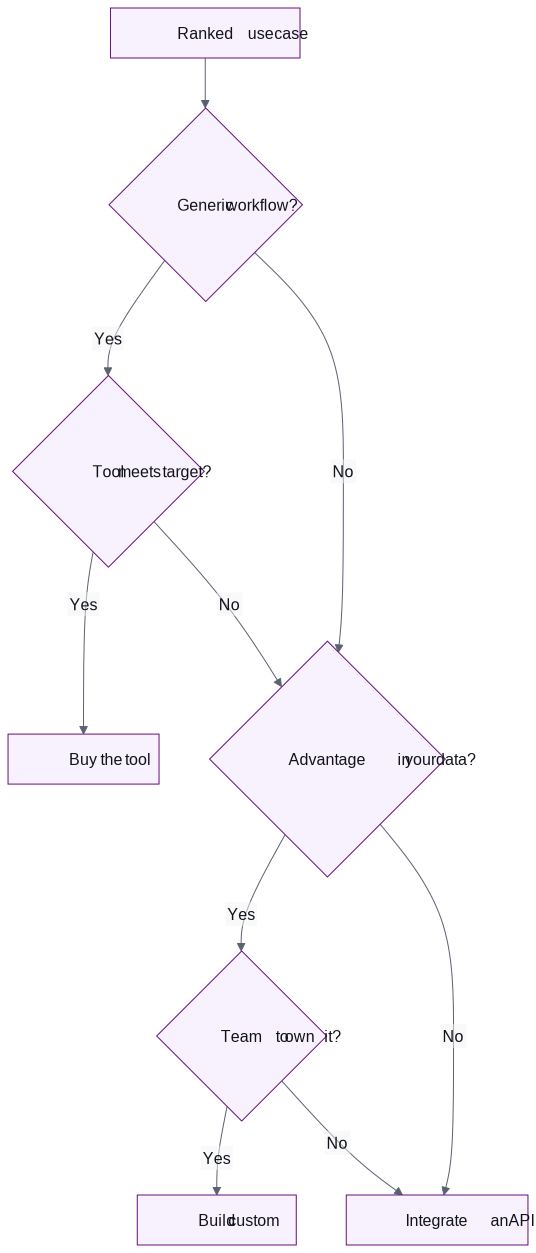
Use four questions, in order. Is the workflow generic, the same as at most companies? If so, test a tool first. Does the best tool reach your baseline target on your own data? If yes, buy it. If not, ask whether the advantage comes from your data or logic. Most use cases then end at the API path. Custom build only makes sense if you also have a team that will own it after launch.
How do you set a baseline before comparing options?#
Measure how the task performs today, without AI, before you look at any vendor or model. Without that number, every option looks good in a demo.
- Name one decision or task. "Triage inbound support tickets" works. "Use AI in support" is too vague to measure.
- Measure today's numbers: time per item, error or rework rate, cost per case and monthly volume. Use real numbers from your systems, not estimates from a workshop.
- Set a target and a floor. The target is the improvement that would justify the spend. The floor is the result below which you stop.
- Build an evaluation set. Collect real past cases with known correct answers. Run every option against the same set: the vendor's tool, your API prototype and any custom model.
- Score the use case on value, frequency, data access and risk. Our AI Strategy practice ranks use cases on exactly these four, against a measured baseline, before recommending build or buy.
This step does more than set up the comparison. Gartner predicted that at least 30% of generative AI projects would be abandoned after proof of concept by the end of 2025. The reasons it gave were poor data quality, weak risk controls, rising costs and unclear business value. A baseline addresses the last of these directly.
When is an off-the-shelf AI tool the right choice?#
Buy when the workflow is generic, the tool meets your target on your own evaluation set, and your data can sit under the vendor's terms.
Buying fits when:
- The task works the same way at most companies. Examples include meeting notes, first-draft emails, code completion and invoice data capture.
- The tool passes your evaluation set, not just its demo. Ask for a trial on your own data, and score it the same way you will score the other options.
- The data terms work for you. Check where data is stored, how long it is kept, whether it is used for training, and whether you can export it.
- It fits your systems. It needs single sign-on, role-based access, audit logs and the connectors your workflow already uses.
- Your team doesn't need to change its behaviour. If the vendor's roadmap is good enough, you don't need your own.
What you give up is control. You can't fix a wrong answer yourself, change the model, or put the AI deeper into your own product.
When should you integrate an API on your own stack?#
Integrate a model API when the advantage comes from your data, permissions or workflow, but a general-purpose model can do the reasoning.
This is where most product features and internal copilots end up. You don't train a model. You build everything that makes a model's answers trustworthy in your setting:
- Retrieval over your data, with permissions checked at query time so users only see documents they're allowed to see.
- An evaluation set that runs on every change to a prompt, model or retrieval setup.
- Guardrails: prompt-injection checks, filtering of personal data, grounding checks and safe ways to refuse.
- Model routing and fallbacks, so you can switch providers when one slows down, fails or raises prices.
- Latency and cost budgets per request, tracked by feature.
That list is how our Generative AI Apps practice works. We write the evaluation set from real user questions before choosing a model or a prompt. To choose the model itself, our guide to the best LLM for enterprise applications explains how to compare models on accuracy, latency, cost and data terms.
When does custom build make sense for AI?#
Build custom only when a tool and an API both fail your evaluation set, the use case is a real competitive advantage, and you will fund a team to run it for years.
Signs that custom is justified:
- Your own data is the product. Examples are a pricing model trained on your transaction history, or a risk score no vendor could reproduce.
- Hosted APIs can't meet your limits. This could be latency, offline or on-premise deployment, or data that can't leave your environment.
- Unit cost at scale. At very high volume, a smaller tuned model can cost less per request than a general one. Prove this with your own token numbers first.
- You can own it. Someone has to version data, monitor drift, keep a rollback model and be on call for it.
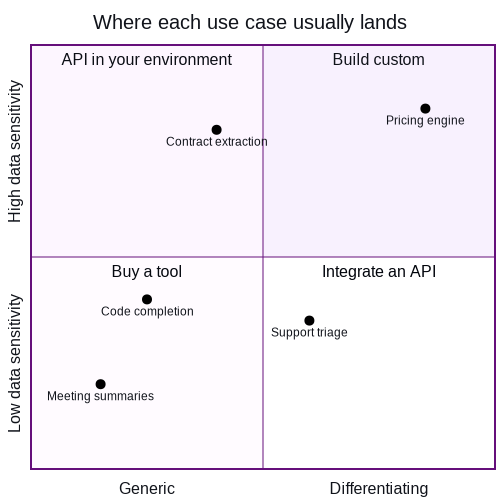
Placing candidates on two axes makes the pattern visible. Meeting summaries are generic and low-sensitivity, so buy. Support triage over your ticket history uses your data but not secret logic, so integrate an API. Contract clause extraction involves sensitive data, so it usually becomes an API build inside your own environment. A pricing engine is both differentiating and sensitive, so it is the strongest custom case.
How do you compare the true cost of each option?#
Compare total cost over three years, including the people who run the system after launch, not just the licence or token bill.
| Cost line | Buy a tool | Integrate an API | Build custom |
|---|---|---|---|
| Upfront build | Setup and connectors | Retrieval, evaluation, guardrails, UI | Data pipelines, model work, serving |
| Running cost | Per-seat or per-use licence | Tokens, vector storage, hosting | Compute, GPUs, storage |
| People after launch | Admin and vendor management | Product engineers who own prompts and evaluations | ML, platform and on-call engineers |
| Time to first result | Shortest | Medium | Longest |
| Cost to switch | Data export and retraining staff | Re-run evaluations on a new model | Low dependence on vendors, high cost of the team |
| Cost growth with usage | Grows with seats | Grows with tokens unless budgeted | Grows with infrastructure |
How to fill it in:
- Price each option against the same volume: your measured monthly volume, plus a growth case.
- Turn people into money. Engineer time spent owning the system is usually the biggest line for API and custom builds.
- Add the cost of being wrong. Multiply the error rate on your evaluation set by the cost of one mistake.
- Put costs next to value. Show the baseline improvement in money for each option.
Rising costs come up again and again in project failures. Gartner expects over 40% of agentic AI projects to be canceled by the end of 2027, citing rising costs, unclear business value and weak risk controls.
What risks should the decision include: data access, lock-in and ownership after launch?#
Score three risks for every option: whether you can legally and practically use the data, how hard it is to leave, and who owns the system after launch.
Data access. For each use case, find out where the data lives, who owns it, how clean it is and whether you're allowed to use it. Answer these before you spend the budget. A buy decision is only as good as the vendor's data terms. An API or custom build needs classification and lineage so you can show what a model used. Our Data Governance & MDM practice includes an AI data-readiness review for this reason.
Lock-in. Keep the parts that make switching possible: your evaluation set, your prompts, your retrieval index and your logs. With those, moving to a new tool or model means re-running tests, not starting again.
Ownership after launch. Name one owner for each AI system. Give them a budget, an alert on quality drift, and the authority to roll back.
Regulatory role. Under the EU AI Act, most obligations fall on providers (developers) of high-risk AI systems, not on the organisations that deploy them. If you build a high-risk system yourself, you may take on the provider's duties. Most high-risk requirements begin applying on 2 December 2027. For a structured risk review, NIST's AI Risk Management Framework has a Generative AI Profile (NIST AI 600-1), released July 2024.
How do you turn the decision into a 90-day pilot?#
Turn the scored decision into a time-boxed pilot. Give it one use case, one metric, a target, a floor and a date when you decide to scale or stop.
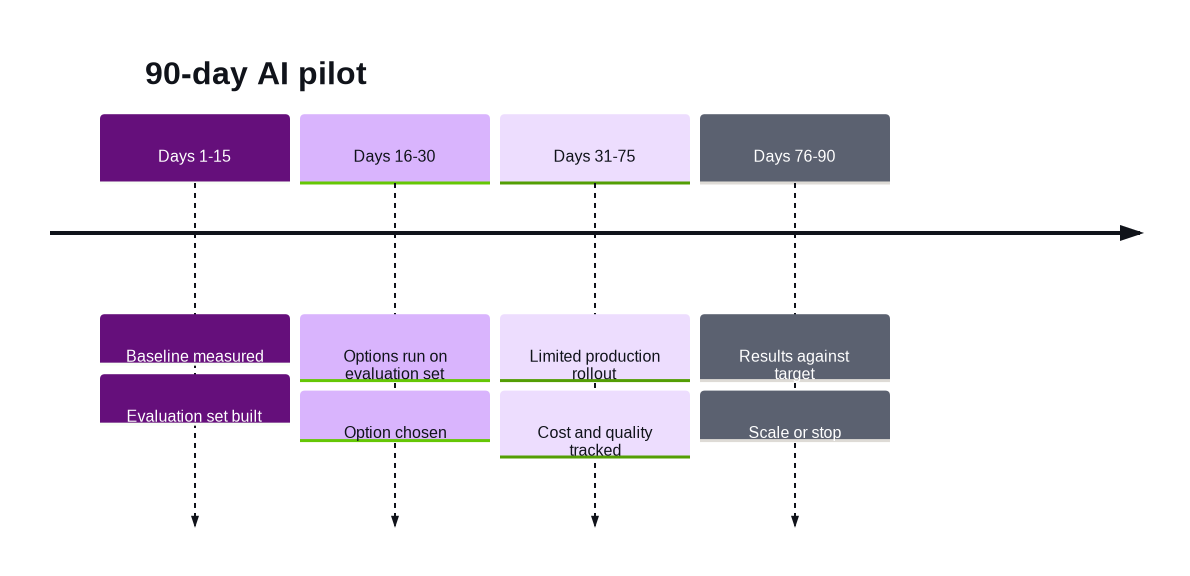
Each phase needs:
- Days 1–15: the baseline numbers, the evaluation set and success criteria agreed by the business owner.
- Days 16–30: the shortlisted tool, the API prototype and (rarely) a custom prototype, all scored on the same set. Choose one.
- Days 31–75: a limited rollout to real users. Every change goes through tests, security checks and senior engineer review, whether a person or an AI wrote it. Track cost per request from day one.
- Days 76–90: compare results with the target and the floor. Stop criteria are written at the start, not made up at the end.
Our enterprise AI strategy roadmap covers the same plan across several use cases, with named owners and milestones.
Conclusion#
Build vs buy for AI comes down to measurement. Measure the task as it runs today, test a tool, an API build and (only if needed) a custom system against the same evaluation set, and compare three-year cost including the people who run it. Most teams find that buying covers generic workflows, an API build covers their product features, and custom work is right for a small number of use cases. Prove the choice in a 90-day pilot before you fund it at scale.
We start every engagement with a paid pilot: one pod, one outcome, success criteria agreed up front, and no long-term contracts.
Frequently asked questions
Is it cheaper to buy or build an AI tool?
Buying usually costs less to start, and you see results sooner. API and custom builds cost more upfront, but the cost per request can be lower at high volume, and you control the roadmap. The fair test is a three-year cost that includes the engineers who run the system after launch, compared with the money value of the baseline improvement.
How big should an AI evaluation set be?
It should be big enough to cover the real mix of cases your users bring, including edge cases and the ones where errors cost the most. Take it from real historical data with known correct answers, not invented examples. Grow it over time by adding every production failure you find.
Can we start with a bought tool and move to a custom build later?
Yes. This is a sensible path if you keep your evaluation set, prompts, logs and data exports from the start. Those let you score a later API or custom build against the tool you already run. Check the vendor's data export terms before you sign, so switching stays possible.
Does integrating a model API count as building or buying?
It's a mix of both. You rent the model, but you build and own everything around it: retrieval, permissions, evaluation, guardrails, routing and cost controls. For most enterprise product features, this middle path gives enough control without the cost of training and serving your own models.
Who should own an AI system after the pilot ends?
Name one owner, with a budget, a quality-drift alert and the authority to roll back changes. Without a named owner, quality and cost tend to slip quietly once the pilot team moves on. Make ownership a condition for moving from pilot to scale.
- AI strategy
- build vs buy
- generative AI
- decision framework
- AI pilots
Newsletter
Get new articles by email
A short monthly round-up of what we've written on engineering pods, quality and AI. No spam.
