
AI automation projects usually fail for organisational reasons, not because the model is weak. The pilot never had one measurable outcome or a baseline to beat. The agent got more access than its task needed, with no human approval on risky steps. And nobody owned evaluation or upkeep after launch. Each of these shows up within the first 90 days.
The pattern is well documented. Gartner predicted that at least 30% of generative AI projects would be abandoned after proof of concept by the end of 2025. It named poor data quality, inadequate risk controls, escalating costs and unclear business value as the causes. For agents specifically, Gartner expects over 40% of agentic AI projects to be canceled by the end of 2027. This guide sorts those failures by cause so you can find the one affecting your project.
Why do most AI automation projects stall after the demo?#
A demo shows the model can do a task once. Production needs it to do the task reliably, safely and measurably on inputs nobody hand-picked.
That gap is mostly about how the project is run, not the technology. RAND's study of AI project failure interviewed data scientists and engineers and found five root causes. The most common one was misunderstanding or miscommunicating what the project was for. Others were weak data and underinvesting in the infrastructure needed to deploy. MIT's Project NANDA reported that 95% of enterprise generative AI pilots showed no measurable financial return.
In practice, most stalled automation projects fit one or more of four failure modes:
| Failure mode | What you see | What fixes it |
|---|---|---|
| Unclear outcome | "Automate support" instead of one metric | One workflow, one number, one target |
| No baseline | Nobody can say if the pilot helped | Measure the manual process before building |
| Unsafe actions | Security blocks go-live, or an incident ends it | Scoped permissions, human approval on risky steps |
| No evaluation or owner | Quality drifts after launch, users bypass it | Evaluation suite on every change, a named owner |
What does a failing AI automation project look like in the first 90 days?#
It looks busy: demos, prompt tweaks and a growing list of tools. But no number has moved, and nobody can say which number should.
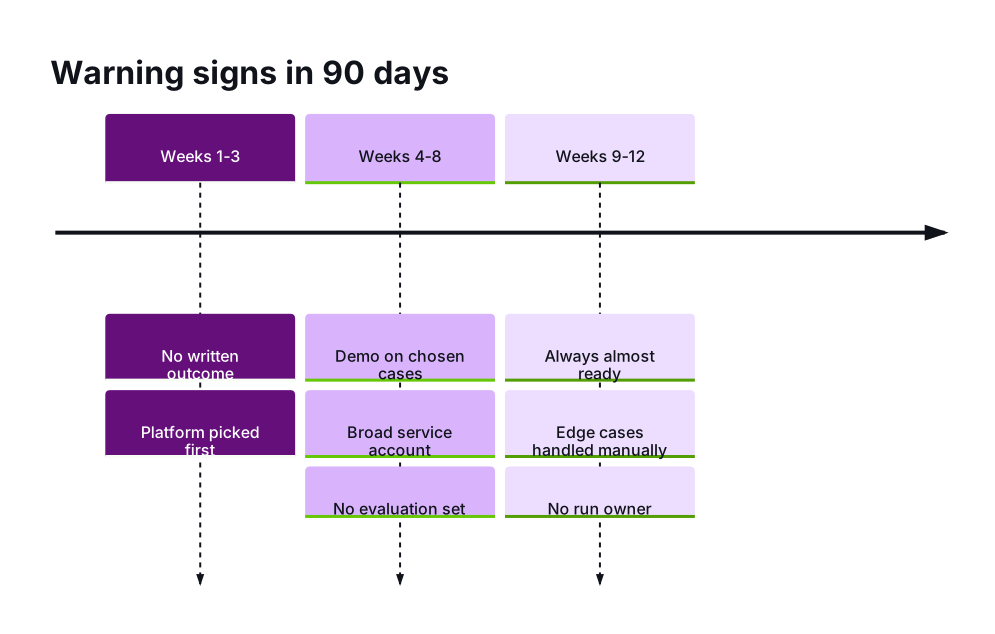
The warning signs tend to show up in this order. In the first few weeks, the project kicks off without a written outcome, and a platform gets picked before anyone has named the decision it should improve. In the middle stretch, the demo runs on hand-picked cases, the team asks for a broad service account "to unblock testing", and nobody has built an evaluation set. Near the end, status reports say "almost ready" week after week. People quietly handle the edge cases by hand, and nobody has been named to run the automation once it's live.
Why do automation projects fail without a measured baseline?#
Without a baseline you can't show the automation helped. So the project loses its budget the first time someone asks what it returned.
A baseline is the current, measured performance of the manual process. Measure it before you build anything. For a workflow such as invoice exception handling, that means:
- Volume: cases per week, and how much that varies
- Handling time: minutes per case, including rework
- Error rate: cases that come back or need correcting
- Cost per case: loaded staff cost plus tooling
- Escalation rate: share of cases that need a specialist
Then write down a target and a stop rule before the pilot starts. For example: "Cut median handling time by a set percentage by a fixed date, or stop." Our AI Strategy work scores each candidate use case on value, frequency, data access and risk against a measured baseline. It ends in a 90-day plan with owners, milestones and stop criteria. For the full method, see our post on building an enterprise AI strategy and 90-day roadmap.
Why do AI agents and workflows break when they touch real systems and data?#
Real systems contain the inputs the demo avoided: messy records, permission boundaries, rate limits, partial failures, and data nobody has cleared for AI use.
The usual breaking points:
- Data quality. The same customer appears in three systems with three addresses, so the agent acts on the wrong one.
- Partial failures. An API call times out halfway through a multi-step workflow. Without retries that are safe to repeat and a way to undo, you're left with half-finished actions.
- Permission boundaries. Retrieval pulls documents the requesting user was never allowed to see.
- Missing deployment work. Logging, monitoring, secrets handling and rollback were never budgeted. This matches RAND's finding about underinvestment in deployment infrastructure.
- No evaluation set. Every prompt, model or tool change is a guess that ships to production.
The fix for the last one is the same discipline you'd apply to any code: a scored set of test cases built from real inputs, including the ugly ones. Run it on every change, and block release when scores drop.
How do unclear permissions and missing human approvals cause failures?#
An agent with broad access can turn one wrong output or injected instruction into a real action. The first serious incident usually ends the project.
Security teams know this risk. In the 2026 OWASP Top 10 for LLM Applications, excessive agency rose from sixth to third place because more applications now call tools and act on outside systems. OWASP breaks the risk into three root causes: the agent can reach more tools than it needs (functionality), has more access than it needs (permissions), or acts without enough oversight (autonomy).
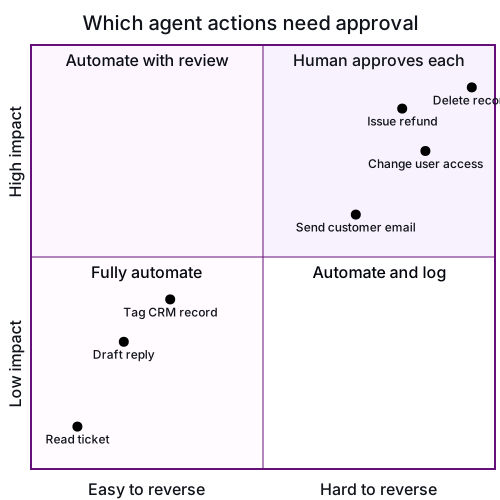
A practical way to scope this is to rate every action by impact and by how hard it is to undo. Reading a ticket or drafting a reply for review can be fully automated. Tagging a CRM record is low risk and easy to fix. Sending a customer email, issuing a refund, changing user access or deleting a record should each wait for a person to approve.
Our AI Agents & Automation practice builds agentic workflows with scoped permissions, a full audit trail and a person approving every risky action. The controls themselves are covered in Production AI Agents: Guardrails & Audits.
Why does no one own the automation after launch, and how does that kill it?#
Pilots are staffed like projects, but automations behave like products. When the pilot team moves on, inputs drift and models change, and nobody notices until users stop trusting the output.
The decline is quiet. Nothing breaks on day one. Then a vendor updates a model, an upstream team renames a field, or a new kind of request starts arriving, and accuracy slips. With no owner and no evaluation running, people start handling cases by hand again. Usage drops, costs stay the same, and the automation is retired. Escalating costs are one of the reasons Gartner gives for agentic projects getting canceled.
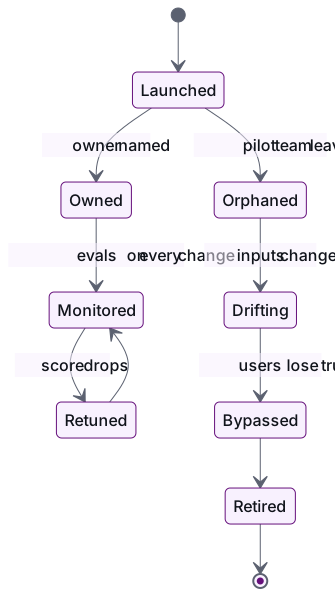
Ownership means four concrete things:
- A named business owner, accountable for the metric
- A named technical owner who is on call for failures
- An evaluation suite that runs on every prompt, model or tool change
- A cost-per-run budget, reviewed against the baseline every quarter
How can you tell an automation project is failing before the budget is spent?#
Ask five questions at every checkpoint. If two or more get no clear answer, the project is failing, however good the demo looks.
- What single metric are we moving, and what were its baseline and target?
- What is the evaluation pass rate on real inputs, and is it trending up?
- What can the agent do without a person, and who signed off on that list?
- What does one run cost compared with handling the case manually?
- Who is on call the week after launch?
Add a dated stop rule to the plan. A project with no agreed way to end tends to keep consuming budget.
How do you restart or scope a failing AI automation project?#
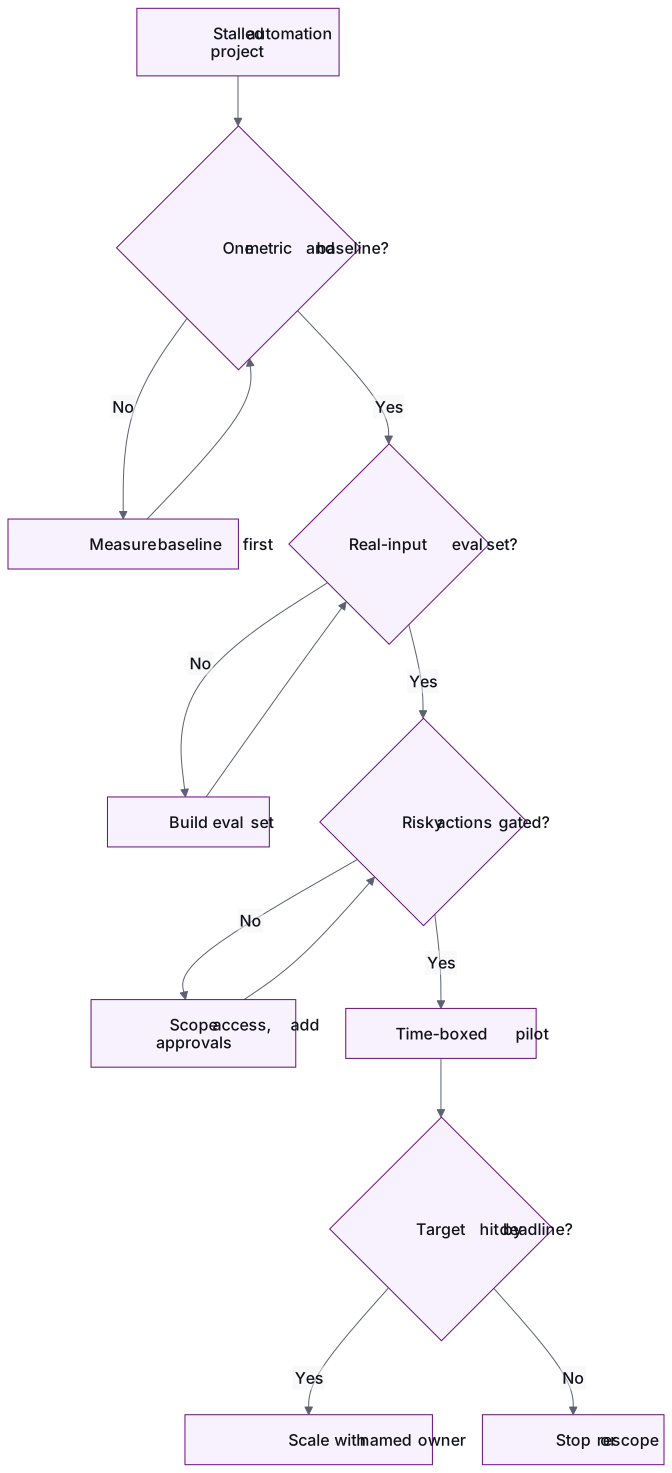
Stop adding features. Shrink the project to one workflow with one metric, measure the baseline, build an evaluation set, gate the risky actions, and run a short pilot with a scale-or-stop rule agreed in advance.
Each check below has to pass before the next one starts:
Some practical scoping rules:
- Pick the narrowest workflow that still matters. One queue, one document type or one approval chain.
- Keep the existing tools if they work. Changing platforms rarely fixes a project that had no outcome defined.
- Staff it as a team that will run it, not one that hands it over at go-live.
- Agree the success criteria in writing up front, including what result means stop.
This is how our engagements start: a paid pilot with one pod, one outcome, and success criteria agreed before work begins. You judge working software, not a pitch.
Conclusion#
AI automation projects rarely fail because the model can't do the task. They fail because nobody named the outcome, measured where it started, limited what the agent could touch, or took ownership after launch. Each gap shows up early, and each has a specific fix. If your pilot has stalled, run the five checkpoint questions this week, and restart small enough to prove the result within a quarter.
Frequently asked questions
What percentage of AI automation projects fail?
Estimates vary with how "failure" is defined. Gartner predicted at least 30% of generative AI projects would be abandoned after proof of concept by the end of 2025, and expects over 40% of agentic AI projects to be canceled by the end of 2027. MIT's Project NANDA found 95% of enterprise generative AI pilots showed no measurable financial return.
Is the AI model usually the reason a project fails?
Rarely. RAND's research found the most common cause was misunderstanding or miscommunicating what the project was for. Data quality and underinvestment in deployment infrastructure also ranked high. Swapping models seldom rescues a project with no defined outcome or baseline.
Should we cancel a stalled AI automation pilot or restart it?
Restart it if you can name one workflow, one metric and a baseline, and the data the workflow needs is available and cleared for use. If you can't name any of those after an honest review, stop the project and put the budget toward a use case that scores better on value, data access and risk.
Which actions should an AI agent never take without human approval?
Anything with high business impact that is hard to undo. Examples are issuing refunds or payments, changing user access, deleting records and sending messages to customers. Low-impact, easily reversed actions such as reading tickets or drafting replies for review can usually run automatically, with every action logged in an audit trail.
How long should an AI automation pilot run before a scale-or-stop decision?
Long enough to measure the target metric against the baseline on real volume, and no longer than the stop date agreed at the start. Many teams work within a 90-day plan, with checkpoints in between using the five questions above. The key is setting the date and the threshold in writing before the pilot begins.
- AI Automation
- AI Strategy
- AI Agents
- Project Management
- AI Governance
Newsletter
Get new articles by email
A short monthly round-up of what we've written on engineering pods, quality and AI. No spam.
